Three days after I came home from the hospital, my mother-in-law walked into the kitchen, looked at the chai I’d made for myself, took it right out of my hand, replaced it with a glass of warm ajwain water, and said:

I was exhausted, slightly delirious, and honestly really wanted my chai back.
But she was right.
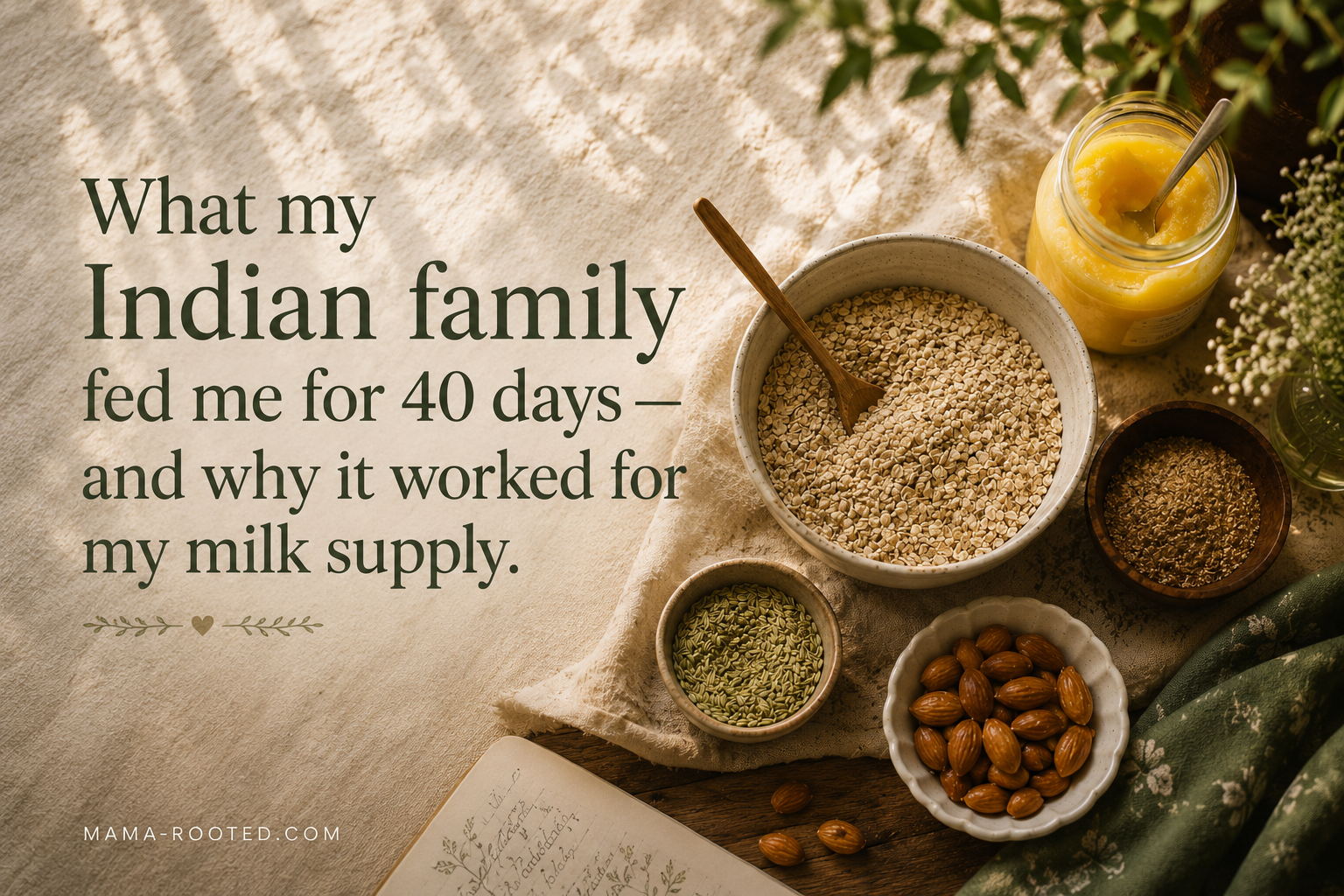
In Indian households, the first forty days after birth — the chilla or japa maas — are treated as a sacred recovery window. The diet is deliberate. Every ingredient has a purpose. It’s not just food, it’s medicine. And as a vegetarian trying to breastfeed for two years, I leaned into this hard.
I also wanted to know the why behind it. Why oatmeal in every lactation cookie recipe? What were the soaked almonds actually doing? Was the fennel water just for digestion or something more?
This post is what I learned — from lived experience, from my family, and from the science that quietly backed up what Indian women have known for centuries. None of it is magic. All of it helped.
First — what even is a galactagogue?
A galactagogue is any food or herb believed to support or increase breast milk production. And here’s the honest truth: the science on most of them is still catching up. We don’t have a mountain of clinical trials. What we do have is centuries of cross-cultural use, a body of emerging research, and a very simple truth — the foods most commonly used as galactagogues are also just excellent food for a postpartum body.
A well-nourished, well-rested body that feeds frequently makes milk. The galactagogue supports the system. It doesn’t replace the feeding.
Affiliate Disclosure: This post contains affiliate links. I may earn a small commission at no extra cost to you. I only recommend things I have personally used or carefully researched.
What I actually ate — and why
Every other morning, sometimes daily. Steel-cut oats, warm, with soaked almonds and a drizzle of ghee. Not glamorous. Completely grounding.
Oats contain beta-glucan, which may help stimulate prolactin — the hormone that signals your body to make milk. They’re also good for iron, and low iron is a real reason some moms see supply dip. The comfort factor is real too — a warm familiar meal that lowers your stress is genuinely supporting your let-down. That’s physiology, not wishful thinking.
How I used it: Steel-cut or rolled oats — never instant. Cooked with cardamom, topped with soaked almonds, a little ghee, sometimes stewed mango. Ground flaxseed stirred in most mornings.
Fennel + ajwain water — the morning ritual
Every single morning for six weeks, my mother-in-law steeped equal parts fennel seeds and ajwain (carom seeds) in hot water, strained it, and handed it to me before I’d even fed the baby. I thought it was just for digestion — and it is, postpartum constipation is very real — but it was doing more than that.
Fennel contains a compound called anethole which may interact with prolactin pathways. It also passes digestive comfort to the baby through milk, which is something I genuinely noticed. Ajwain supports gut health, and a gut that isn’t absorbing properly can’t supply nutrients to milk no matter what you eat. The pairing is intentional.
How I used it: Equal parts in hot water every morning.
Sesame + flaxseed — the calcium and omega-3 team
As a vegetarian, calcium was one of my biggest worries. Your body will pull from your own bone density to keep breast milk calcium-rich. So if you’re not replenishing it, you are the one paying the price.
Sesame seeds — in chutney, in til laddoos, sprinkled on rice, blended into tahini — were in our kitchen daily. Ground flaxseed went into my oats every morning. The omega-3s from flaxseed actually make it into breast milk and support baby’s brain development. It’s worth noting that flaxseed needs to be ground — whole seeds pass through without being absorbed. Always ground.
How I used it: Flaxseed into oats daily. Sesame in chutney, tempering, tahini, and til laddoos made in a batch before the due date.
Almonds — the snack that was always within reach
I soaked ten almonds the night before, peeled them in the morning, and it became a ritual I came to love.
I also kept a jar of almond butter on my nightstand. Breastfeeding burns roughly 500 calories a day and I would wake up at 2am absolutely ravenous. Having something calorie-dense and actually nutritious within arm’s reach without going to the kitchen is not a luxury — it is survival. If nothing else, do this.
Chickpeas — my protein problem-solver
Getting enough protein as a vegetarian postpartum requires actual intention. It doesn’t just happen. Chickpeas became one of my most reliable sources — in curries, as salad, and most consistently as hummus that lived permanently in my fridge.
The hummus came with tahini, which meant I was getting sesame’s calcium and phytoestrogen benefits folded in without even thinking about it. That’s the kind of effortless nutrition that actually works when your brain is running on no sleep.
My hummus formula: Three tablespoons of tahini minimum. Lemon, garlic, olive oil. Made a big batch every four days. Eaten on crackers, on toast, with vegetables, occasionally just on a spoon at 11pm.
Brewer’s yeast — make the cookies before you give birth
I made lactation cookies two weeks before my due date, stored them in the freezer, and had my husband put five on a plate every night so they’d be thawed by the 2am feed. This is the planning nobody tells you about.
Post-delivery you will not be baking. You will not be doing anything that requires sustained standing. Make them before. Freeze them. You will thank your pregnant self a hundred times over.
Brewer’s yeast is one of the most consistently reported galactagogues in US breastfeeding surveys. It’s also packed with B vitamins that support energy and mood — both very relevant in postpartum. In cookie form you won’t taste the bitterness at all.
My base recipe: Rolled oats, almond butter, coconut oil, brewer’s yeast, ground flaxseed, dark chocolate chips, honey or maple syrup. No oven needed if you roll into balls. Freeze for up to three months.
Ghee — not optional in our house
Ghee went into everything. My oatmeal. My dal. My khichdi, which I ate almost daily in the first two weeks because it’s warm and nourishing and requires minimal chewing at 3am. My family would have been concerned if I wasn’t using it.
Ghee is clarified butter — pure butterfat, milk solids removed. It carries fat-soluble vitamins A, D, E and K2 and is traditionally believed to support digestion and gut recovery postpartum.. Your gut after delivery needs support, and ghee is one of the most bioavailable ways to give it. Ayurveda has documented this for thousands of years. Nutrition science arrived at the same conclusion.
For vegan mamas: coconut oil is the closest alternative — good digestibility, similar gut support profile. The principle is the same: prioritise quality fat.
Moringa — the one I’d tell every breastfeeding vegetarian about
Moringa (drumstick leaves) is one of the most studied plant-based galactagogues globally, particularly in South Asian research. It’s also one of the most nutrient-dense greens you can get. In leaf form it went into our dals and sabzis. In powder form a small teaspoon stirred into smoothies.
If you’re vegetarian and breastfeeding and not using moringa, consider adding it. It’s easy, it’s effective, and a little goes a long way.
Quick reference — everything in one place
If you’re exhausted and just want the simple version, here’s everything I kept coming back to again and again. This is the full list. The “Amazon find” column is there if you want a starting point.
| Food | Why it helps | Vegan? | Amazon find |
| Coconut Oil | Great Source of Healthy Fats | Yes | https://amzn.to/4vn2UAX |
| Oatmeal | May boost prolactin; good for iron | Yes | Quaker rolled Oats |
| Fennel seeds | Phytoestrogens; milk volume + colic relief for baby | Yes | Organic Fennel Seeds |
| Ajwain / carom seeds | Digestive support + milk production | Yes | Organic Ajwain Seeds |
| Ground flaxseed | Omega-3 ALA into breast milk; phytoestrogens | Yes | Organic Ground Flaxseed |
| Sesame seeds / tahini | Calcium, iron, zinc — critical for vegetarians | Yes | Soom Premium Tahini |
| Almonds (soaked) | Calcium, vitamin E, healthy fats | Yes | Barney Almond Butter Raw Almonds |
| Chickpeas | Protein, iron, isoflavones | Yes | Organic Canned Chickpeas |
| Avocado | Calorie-dense healthy fat; supports milk fat quality | Yes | Better Body Avocado Oil |
| Brewer’s yeast | B vitamins, iron, protein — energy + mood | Yes | Lewis Labs Brewer’s Yeast |
| Ghee | Fat-soluble vitamins A/D/E/K2; butyrate for gut healing | No | Ancient Organics Grass-Fed Ghee |
| Moringa powder | One of best-studied plant galactagogues; vitamins + minerals | Yes | Organic Moringa Powder |
| Methi (fenugreek leaf) | Phytoestrogens — leaf is gentler than seed | Yes | Dried Methi Leaves (Kasuri Methi) |
The thing I want you to actually hear
Food does not make milk on its own.
I say this because in my most anxious new-mother moments I convinced myself that if I could just eat the right things, supply would sort itself out. That’s not how it works. Milk production is demand-driven — your body makes milk in response to milk being removed. Frequency of nursing or pumping is the single biggest factor. Full stop.
What galactagogues do is support the environment your body is operating in. They are the fertile soil. The nursing is the rain. One without the other doesn’t work.
If you’re genuinely worried about supply, please call a lactation consultant before you do anything else. A good IBCLC will see things no food list can.

My mother-in-law was right. Slow down. Eat intentionally. Let your body do what it was built to do.
– With love, Mama Rooted

Save this post and share it with a vegetarian or vegan mama who’s figuring out breastfeeding. She needs this list. 🤍

Leave a Reply