Category: Breastfeeding

  • Breastfeeding & Pumping on the Go: What I Actually Pack

    Breastfeeding & Pumping on the Go: What I Actually Pack

    Affiliate disclosure: This post contains affiliate links. I may earn a small commission at no extra cost to you. I only recommend products I believe are genuinely useful for fellow moms.


    The first few times I left the house with a breastfed baby, feeding felt like the thing I had to plan the entire outing around.

    Where would I feed?

    What if she got hungry?

    What if I needed to pump?

    Where would I keep the milk?

    What if there wasn’t a fridge?

    What if I forgot something?

    Eventually I realised I didn’t need to carry my entire feeding station with me.

    I just needed a few things that solved the problems that actually came up.

    Because breastfeeding outside the house is usually pretty simple once you’ve figured out your system.

    Here’s what I actually found useful.


    For the pumping mama

    Momcozy M5 Wearable Breast Pump

    If you’re pumping on the go, a wearable pump can make the whole process feel dramatically less complicated.

    The M5 sits in your bra without tubes or a power cord, so you can pump without finding an outlet or setting up a traditional pump. Momcozy lists the M5 as a hands-free, cord-free wearable pump with multiple modes and suction levels.

    I’ve used mine in an airport terminal, in the back of a car and in a café.

    The biggest benefit wasn’t that I could suddenly do everything while pumping.

    It was that pumping didn’t automatically mean stopping everything else.

    Charge it before you leave. Make sure the parts are clean and dry. Put it somewhere you can reach easily.

    That’s it.


    Momcozy Portable Breast Milk Cooler

    This is the product that made longer days out much less stressful for me.

    Before having a dedicated milk cooler, every outing involved the mental maths:

    When did I pump? Where’s the fridge? How long are we going to be out?

    The Momcozy 22oz cooler is designed to hold two 11oz bottles and keep milk chilled for 24+ hours when the cooling tube is fully frozen and the cooler stays closed.

    That doesn’t mean you can ignore normal breast milk storage guidance. The CDC says expressed milk can be transported in an insulated cooler with frozen ice packs for up to 24 hours while travelling, and it should be refrigerated or frozen once you reach your destination.

    For me, though, the biggest benefit wasn’t the number of hours.

    It was not having to spend the entire outing looking for a fridge.


    Bottles or milk storage containers

    If you’re pumping while you’re out, you’ll need somewhere to put the milk.

    That might mean breast milk storage bags, storage bottles or the bottles you’ll eventually feed the baby from.

    I wouldn’t overcomplicate this.

    For a short outing, bring enough storage for what you’re realistically expecting to pump.

    If you’re pumping specifically so baby can have expressed milk while you’re away, remember that you’ll also need a clean feeding bottle.

    The goal is simply to keep the milk contained, cold and easy to access.


    Clean spare pump parts

    This is one of those things that sounds excessive until you’re sitting somewhere with milk-covered pump parts and no sink.

    For shorter outings, I often prefer carrying a clean spare set of pump parts rather than trying to wash everything immediately.

    Pump.

    Swap the parts.

    Store the used ones safely.

    Deal with the washing when you’re somewhere that actually has a proper setup.

    For me, this was often easier than turning a café bathroom into a makeshift pump-cleaning station.

    And if you’re going to be out for a full day, a spare set gives you a lot more flexibility.


    Portable pump-parts washing kit

    For longer days, work days and travel, a small washing kit can be worth the space.

    Think:

    • Small pump-parts brush
    • Travel-size dish soap
    • Small clean container or wash basin
    • Clean drying supplies

    You don’t need to bring this for every coffee run.

    But if you’re going to be pumping multiple times away from home, having a way to properly wash your parts becomes much more useful.

    My general rule:

    Short outing: clean spare parts.

    Long day: washing kit or spare parts, depending on what makes more sense.

    Back home: wash everything properly.

    That feels much more realistic than pretending one wipe has magically cleaned an entire pump.


    Pump wipes + pump wash

    I keep pump wipes in the outer pocket of the bag for exactly those moments when I’m away from a proper washing setup.

    They’re convenient.

    They’re quick.

    And they’re absolutely not a replacement for properly washing pump parts.

    That’s the distinction I wish more packing lists made.

    Wipes are for getting through the outing.

    They’re not permission to skip proper cleaning indefinitely.

    So my system is:

    Short outing: wipes can help you get through the outing.

    Long day: bring clean spare parts or a washing kit.

    Back home: wash everything properly.


    Portable bottle warmer — if you actually need one

    A portable warmer is useful if your baby strongly prefers warm expressed milk and you’re going to be away from somewhere that can safely warm a bottle.

    But here’s the thing I wish someone had told me earlier:

    You may not need one.

    Breast milk doesn’t have to be warm. Expressed milk can be served cold, at room temperature or warm.

    So if your baby happily drinks cold or room-temperature milk, that’s one less thing to carry.

    Mine preferred hers warm, so this made travel days much, much easier.


    Cleaning and sanitizing for longer trips

    Microwave steam bags

    These aren’t something I would automatically throw into the bag for a coffee run.

    They’re much more useful for:

    • hotel stays
    • work trips
    • overnight travel
    • longer days where you have access to a microwave

    Steam bags can be useful for sanitizing or steam-cleaning pump parts after they’ve been properly washed. The CDC includes microwave steam as one option for sanitizing feeding items, following the manufacturer’s instructions.

    So think:

    clean first, steam when appropriate.


    For the breastfeeding mama

    Nipple cream

    This lives in my outer pocket rather than buried somewhere in the bag.

    If you’re prone to soreness or irritation, having nipple cream immediately available can make a long day out much more comfortable.

    I especially liked having a small tube with me because the moment you discover you need it is usually not the moment you want to start digging through a full changing bag.


    Disposable nursing pads

    Pack more than you think you’ll need, particularly during the early months when leaking can be unpredictable.

    A baby crying nearby.

    Hearing another baby feed.

    Going longer between feeds.

    Sometimes your body simply decides it has its own schedule.

    You don’t need six pads because I said six pads.

    Pack enough that a leaking top doesn’t become the emergency of the afternoon.


    Nursing cover — if you want one

    Entirely optional.

    Some mamas are completely comfortable feeding in public without one. Some prefer having a little extra coverage.

    Both are fine.

    And if you do use one, this lightweight muslin one is breathable and comfortable for both mamas and babies.


    A large water bottle with a straw

    This one gets its own section because breastfeeding thirst is a different category of thirst.

    It arrives suddenly, completely, and usually at the exact moment your baby is latched and you cannot get up.

    The bottle needs to be:

    • Large enough to last through the outing
    • Easy to reach with one hand
    • Easy to drink from without unscrewing a lid

    The HydroJug Traveller is the one I kept in the changing bag.

    It holds plenty, stays cold and has a built-in straw, which meant I could actually drink while feeding rather than discovering two hours later that I had barely had any water.


    One-handed snacks

    Feeding a baby burns calories.

    Pumping burns calories.

    Doing either while navigating a café, airport or train with a baby burns whatever patience you had left.

    Keep two genuinely easy snacks in the outer pocket of the bag.

    Not because they’re a cute “mama essential.”

    Because eventually you’re going to be starving while your baby is latched and your water bottle is on the other side of the room.

    Anything you can eat with one hand is fair game.

    Protein bars. Trail mix. Nuts. Whatever you’ll actually eat.


    Hand sanitiser

    Keep it somewhere you can reach easily.

    Soap and water are best when they’re available. If they aren’t, the CDC recommends an alcohol-based hand sanitizer containing at least 60% alcohol.

    This is particularly useful before handling bottles, pump parts or feeding supplies.

    And if your hands are visibly dirty, find soap and water when you can.


    The actual quick-packing checklist

    This is the part I’d screenshot.

    If you’re breastfeeding

    If you’re pumping

    Everything above plus –

    For everyone

    • Hand sanitiser
    • One extra muslin/burp cloth
    • One-handed snack

    For a full day or travel day

    This is where I would add the extras:

    You don’t need all of these for every outing.

    That’s the whole point.


    What I wouldn’t automatically pack

    You don’t need to turn the changing bag into a mobile feeding station.

    For a short outing, I wouldn’t automatically bring:

    • A bottle warmer
    • Steam bags
    • A full washing kit
    • Multiple backup bottles
    • Every pump accessory you own
    • A dedicated nursing cover if you don’t use one

    If you’re breastfeeding and not pumping, you may need surprisingly little.

    If you’re pumping, a clean spare set of pump parts may be more useful than a full washing setup for a shorter outing.

    Pack for the outing you’re actually taking — not the hypothetical disaster you’re imagining.

    That one rule has saved me from carrying an absurd amount of stuff.


    The first time you leave the house with everything packed…

    The first time you leave the house with a baby, feeding can feel like the thing you have to plan the entire outing around.

    It doesn’t have to.

    The goal isn’t to carry everything.

    It’s to know what your baby needs, put those things somewhere you can actually reach them, and leave the house without wondering whether you’ve forgotten something important.

    Because the outing itself might still be chaotic.

    The baby might still cry in the café.

    You might still end up eating your lunch one-handed.

    You might still forget your own coffee entirely.

    But at least you won’t be standing there thinking:

    “Where am I supposed to find a fridge?”

    That’s the whole point of this list.

    Not perfection. Just one less thing to worry about when you’re already carrying quite enough.


    📌 Save this before your first real day out.

    And send it to the new mama who’s currently trying to fit her entire feeding station into a changing bag.

    Lots of love,
    Mama Rooted


    Also on Mama Rooted

    I tested the Momcozy M5 for a month — the honest wearable pump review

    The postpartum feeding station — how to set up both the day and night station before baby arrives

    What actually goes in the diaper bag — and what you can leave at home

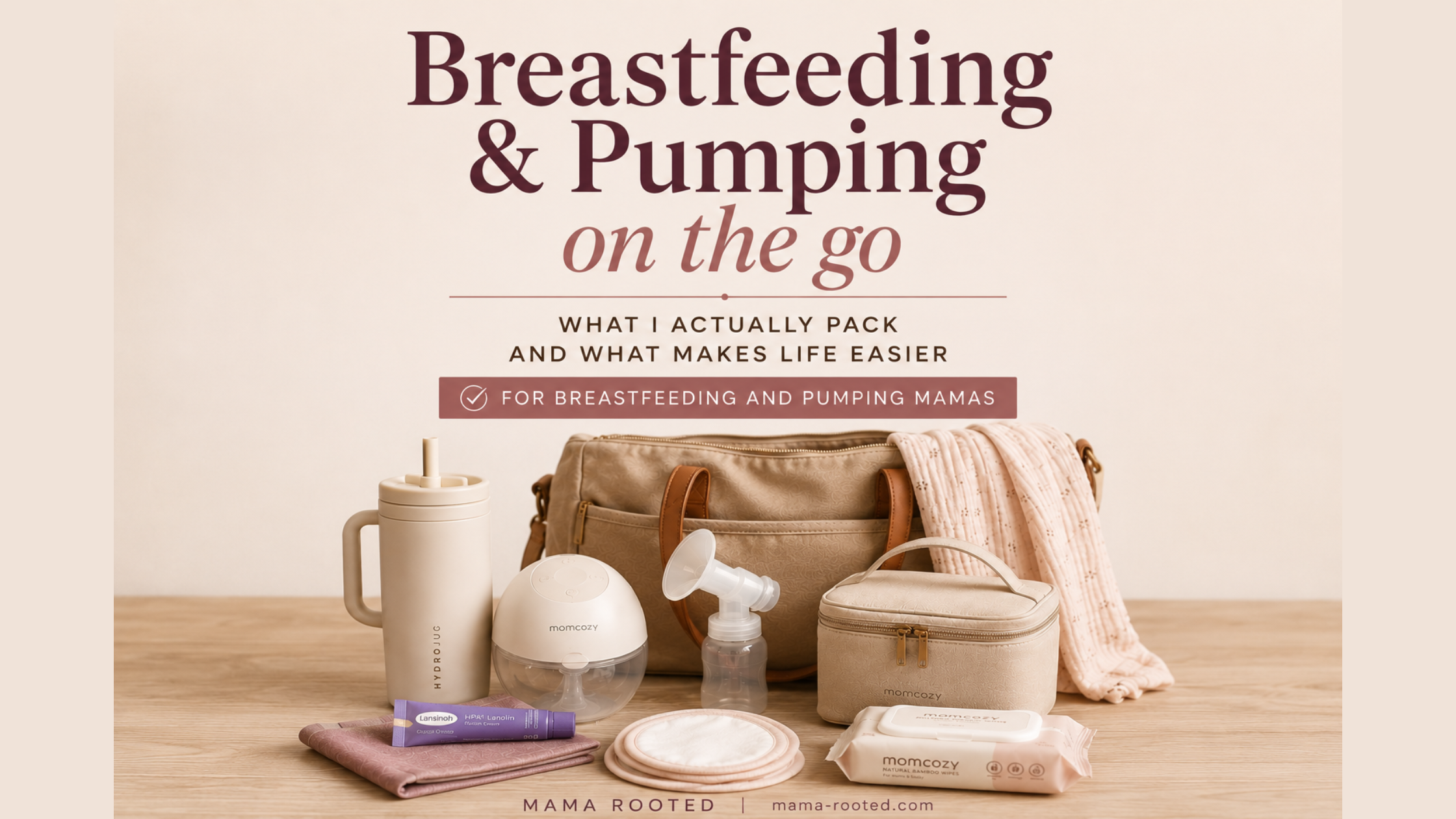
    image showing essentials for breastfeeding and pumping while travelling. Both short and long outings

  • Best Wearable Breast Pumps in 2026: Momcozy M5 vs Elvie Pump Double vs Willow Go vs Eufy S1 Pro

    Best Wearable Breast Pumps in 2026: Momcozy M5 vs Elvie Pump Double vs Willow Go vs Eufy S1 Pro

    ⚠️ Affiliate disclosure: This post contains affiliate links. I may earn a small commission at no extra cost to you. I only recommend products I believe are genuinely useful for fellow moms.


    When I started pumping, the choice was simple: you sat down, you plugged in, you didn’t move for twenty minutes.

    That was pumping.

    That is not what pumping looks like in 2026.

    A wearable pump can sit inside your bra or connect to a small external motor, letting you answer emails, make dinner, travel, or simply hold your baby while you pump.

    The catch?

    There are now a lot of them.

    And the most expensive one isn’t automatically the best one for you.

    So I compared four popular options — the Momcozy M5, Elvie Pump Double, Willow Go and Eufy S1 Pro — and broke down who I’d actually recommend each one to.


    The four pumps at a glance

    Momcozy M5 — best affordable starting point

    Elvie Pump Double — best for comfortable workday pumping. Very very discreet.

    Willow Go — best smart, fully in-bra option

    Eufy S1 Pro — best for features and heated pumping

    One important note before we get into them: prices and included accessories can change, especially during Amazon promotions and insurance periods.


    Before the specs: the one thing that matters most

    The most important question isn’t suction strength or battery life.

    It’s fit.

    A wearable pump can have excellent suction on paper and still work poorly for you if the flange doesn’t fit correctly. Fit affects comfort, seal and milk removal, which is why sizing should be one of the first things you check before buying. Both Momcozy and Elvie specifically emphasize finding the correct flange or insert size.

    And your size isn’t necessarily the same before and after pumping. It is recommended to measure immediately before pumping for the most accurate fit.

    So before you fall in love with a pump because of its color, app or suction number:

    Check the flange options.


    How I compared them

    I looked at the things that actually matter when you’re wearing a pump several times a day:

    • Fit and flange options
    • Comfort
    • How discreet it is
    • Battery life
    • App control
    • Milk capacity
    • Cleaning and assembly
    • Portability
    • Special features
    • Price
    • Who each pump makes the most sense for

    One important caveat: pump specs don’t tell the whole story.

    A pump that gives one mama excellent output may give another disappointing output, even with the same settings. Your anatomy, flange fit, letdown, breast fullness and individual response all matter.

    That’s particularly important with wearable pumps.


    Momcozy M5

    The Momcozy M5 Wearable Blreast Pump

    Best for: Mamas who want an affordable, straightforward first wearable pump.

    The Momcozy M5 is the one I’d look at first if you’ve never owned a wearable pump and don’t yet know whether you’re going to love one.

    It’s fully in-bra, has no tubes or external hub, and uses three pumping modes with nine suction levels. The original M5 is operated directly from the pump rather than through an app.

    Forbes Vetted named the M5 its Best Affordable Wearable Breast Pump in its 2026 roundup.

    The M5 is also relatively lightweight at around 230g per pump, with approximately six sessions of battery life according to Momcozy’s current M5 Smart specifications. The pump has a 160ml/5.4oz collector, although the brand recommends not pumping past 4oz in the cup.

    One important 2026 update

    Momcozy now sells an M5 Smart as well as the original M5.

    The M5 Smart adds app control. The original M5 does not. The core pumping design is otherwise very similar, so make sure you’re buying the version you actually want.

    Functionality: ⭐⭐⭐⭐ 4/5
    Ease of use: ⭐⭐⭐⭐⭐ 5/5
    Discretion: ⭐⭐⭐⭐ 4/5

    Pros

    • Affordable compared with many premium wearables
    • Fully in-bra
    • No tubes or external motor
    • Three pumping modes
    • Nine suction levels
    • Multiple flange/insert options
    • Good battery life
    • Carrying case included
    • Simple on-device controls
    • Comfortable silicone design

    Cons

    • Washable parts are not dishwasher-safe
    • Original M5 has no app control
    • Less feature-rich than the Eufy S1 Pro
    • Wearables may not give every mama the same output as a traditional pump
    • Can be harder to maintain a good seal if you bend forward significantly

    Choose the Momcozy M5 if:

    You want your first wearable pump without spending $300+, you prefer simple controls and you don’t need heat or app connectivity.

    If you want app control, look at the M5 Smart instead.

    Mama Rooted verdict: This is where I’d start for most first-time wearable buyers.


    Elvie Pump Double

    Elvie Pump Double Wearable Breast Pump

    Best for: Mamas who want a genuinely discreet, fully in-bra wearable with smart controls.

    If the Momcozy M5 is the simple, affordable wearable, the Elvie Pump Double is the more polished version of the same basic idea.

    There are no tubes, no external motor and no dangling bottles. Both pumps sit inside your bra, which makes the Elvie particularly appealing if discretion is your biggest priority.

    The app lets you control the pump remotely, monitor milk volume, track pumping sessions and save your preferred settings. If you’re pumping at work, that means you can make adjustments without reaching inside your bra every few minutes.

    Each bottle holds 5oz / 150ml, and the pump automatically pauses when it detects that the bottle is full.

    The Elvie has two pumping modes — Stimulation and Expression — with seven intensity levels. More suction does not necessarily mean more milk. The goal is finding the highest comfortable setting that works for your body.

    Functionality: ⭐⭐⭐⭐⭐ 5/5
    Ease of use: ⭐⭐⭐⭐ 4/5
    Discretion: ⭐⭐⭐⭐⭐ 5/5

    Pros

    • Completely in-bra
    • No tubes or external hub
    • App control
    • Real-time milk-volume monitoring through the app
    • Pumping history and session tracking
    • Two pumping modes
    • Seven intensity levels
    • 5oz / 150ml bottles
    • Automatically pauses when the bottle is full
    • Can be purchased as a double for simultaneous pumping
    • Very discreet under clothing

    Cons

    • Premium price
    • 5oz capacity can be limiting for higher-output sessions
    • More expensive than the Momcozy M5
    • More parts to clean than a very basic wearable
    • The sophisticated design doesn’t necessarily mean it will remove more milk for every mama

    Choose the Elvie Pump Double if:

    You want maximum discretion, you pump regularly and you like the idea of controlling and tracking your sessions from your phone.

    It’s particularly appealing for a mama returning to work who doesn’t want an external motor clipped to her waistband.

    Mama Rooted verdict: If your priority is “I want to pump without looking like I’m pumping,” the Elvie is one of the strongest options in this comparison.


    Willow Go

    Willow Go Wearable Breast Pump

    Best for: Mamas who want a fully in-bra pump with app control and lots of suction adjustment.

    The Willow Go is fully contained in the bra, with no external hub or tubes to manage.

    It offers app control and 15 suction levels, which gives you more adjustment than the M5. It also has dishwasher-safe parts and a 5oz collection capacity per side, with larger 7oz containers available separately.

    That makes it an interesting choice for someone who knows they’ll use a wearable regularly and wants more control over the experience.

    The trade-off is complexity.

    Forbes notes that the Willow Go has six parts to clean and assemble. That’s not necessarily difficult once you’ve learned it, but it’s more involved than the “grab it and go” appeal of the M5.

    Functionality: ⭐⭐⭐⭐⭐ 5/5
    Ease of use: ⭐⭐⭐⭐ 4/5
    Discretion: ⭐⭐⭐⭐⭐ 5/5

    Pros

    • Fully in-bra
    • No tubes
    • App control
    • 15 suction levels
    • Dishwasher-safe parts
    • 5oz collection capacity
    • Larger collection containers available
    • Quiet and designed for discreet pumping

    Cons

    • More parts to clean
    • More involved assembly
    • More expensive than the M5
    • Requires a little more learning before it feels completely intuitive

    Choose the Willow Go if:

    You want a smart, fully in-bra pump, you like having lots of control over suction and you’re prepared to spend more for those features.

    Mama Rooted verdict: This makes more sense as a deliberate upgrade than as a first wearable purchase.


    Eufy S1 Pro

    Eufy S1 Pro Wearable Breast Pump

    Best for: Mamas who specifically want heated pumping, extensive customization and a charging case.

    The Eufy S1 Pro is the most feature-heavy pump in this comparison.

    Its headline feature is HeatFlow, which adds seven levels of warmth from approximately 95–105°F. The pump also offers app control, customizable pumping rhythms, 300 mmHg maximum suction and a wireless charging case.

    The charging case is particularly useful if you’re pumping away from outlets for long periods.

    Forbes Vetted named the S1 Pro its Most Powerful Wearable Breast Pump in its 2026 guide, while specifically noting the heated feature and charging case as major differentiators.

    But here’s the important distinction

    I wouldn’t buy this pump simply because it has a larger suction number.

    The reason I’d consider the Eufy is the combination of heat + customization + portability.

    And that’s a very different buying decision.

    Functionality: ⭐⭐⭐⭐⭐ 5/5
    Ease of use: ⭐⭐⭐⭐ 4/5
    Discretion: ⭐⭐⭐⭐ 4/5

    Pros

    • Heated flange
    • Seven heat levels
    • App control
    • Customizable pumping rhythms
    • 300 mmHg maximum suction according to Eufy
    • Wireless charging case
    • Up to five days of charging-case power
    • Dishwasher-safe parts
    • Under 46dB according to Eufy
    • 5oz collection capacity

    Cons

    • More features means more to learn
    • Bulkier than simpler wearable options
    • Heat isn’t something you should treat as a solution for breast inflammation or suspected mastitis
    • You may not benefit from the extra features enough to justify the price

    Choose the Eufy S1 Pro if:

    You specifically want heated pumping, extensive customization and a charging case, and you’re comfortable paying for those features.

    If you want the heated experience but don’t need the charging case, the standard Eufy S1 is currently listed at a lower price.

    Mama Rooted verdict: The S1 Pro is the “I know exactly what features I want” purchase — not necessarily the pump I’d tell every new mama to buy.


    Quick comparison

    Momcozy M5Elvie Pump DoubleWillow GoEufy S1 Pro
    Approx. price$–$$$$$$$$$$$
    Heat
    Suction adjustment9 levels7 intensity levels15 levels7 intensity levels + 3 speeds
    Battery~6 sessions~3 hours~3 sessionsCharging case
    Best forFirst wearableWorkdaysSmart in-bra pumpingFeatures + heat
    Main trade-offFewer featuresPriceMore partsBulkier

    One thing I’d know before buying any wearable

    A wearable pump is incredibly convenient.

    But convenient doesn’t automatically mean equivalent to a traditional pump.

    Some parents get excellent output from wearables. Others don’t fully empty with them.

    If you’re:

    • exclusively pumping
    • establishing your milk supply
    • pumping for a premature or hospitalized baby
    • relying on pumping for most of your baby’s milk
    • already concerned about low supply

    I’d be more cautious about making a wearable your only pump.

    For many mamas, the sweet spot is:

    traditional pump at home + wearable for work, errands, travel and the days when sitting down to pump simply isn’t realistic.

    That setup gives you convenience without making the wearable responsible for doing everything.


    So which one would I actually buy?

    If you’re new to wearable pumps: Momcozy M5

    This is the easiest recommendation.

    You’re getting the basic wearable experience without immediately spending $300–$350 on a pump that may or may not suit your body.

    And if you later realize you want heat, app control or a charging case, you’ll know what you’re actually upgrading for.

    Start here if you’re unsure.


    If you pump at work: Elvie Pump Double

    If your main goal is sitting at your desk, joining meetings and getting your pumping sessions done without feeling like you’re wearing a piece of equipment under your shirt, the Pump Double deserves a serious look.

    The fit options and soft silicone are its biggest strengths.


    If you want the smartest fully in-bra option: Willow Go

    This is the upgrade pick.

    You get app control, 15 suction levels, dishwasher-safe parts and a fully in-bra design.

    It’s more expensive and more involved to clean, but it gives you more control than the M5.


    If you specifically want heat: Eufy S1 Pro

    The heat is the reason to buy it.

    Not the suction number.

    The heat + app + customization + charging case combination is what makes the S1 Pro different.

    If those features don’t matter to you, I’d save the money.


    The Mama Rooted verdict

    If it were my money and I were new to wearable pumps, I’d start with the Momcozy M5.

    It’s affordable, simple, comfortable and gives you a chance to find out whether wearable pumping actually works well for your body before you spend $300+.


    A final note on flange fit

    Before ordering, check your nipple measurement against the manufacturer’s sizing guide.

    Don’t assume that the flange size you used with another pump will automatically be the right size here. Your fit can change, and different pumps use different flange and insert designs. Momcozy and Elvie both provide sizing guidance and multiple insert options.

    A perfectly good pump with the wrong flange can become a very expensive bad experience.

    Fit first. Features second.


    More from Mama Rooted

    I tested the Momcozy M5 for a full month — the honest week-by-week review

    Breastfeeding in the first week — day by day what actually happens

    Everyone told me my baby was hungry — what I checked before acting on anyone’s worry

    Best Wearable Breast Pumps for 2026
  • Breastfeeding in the first week — what nobody warns you about

    Breastfeeding in the first week — what nobody warns you about

    Nobody warned me about the first week.

    Not the cluster feeding. Not the engorgement. Not the moment I would sit in the dark at 3am wondering if my baby was getting enough milk.

    Everyone talks about breastfeeding like it either works or it doesn’t.

    What nobody tells you is that the first week is often a crash course in sore nipples, second-guessing yourself, and learning to trust a process that feels anything but natural.

    This is the post I needed during those first seven days.

    And if you’re in the middle of it right now, I hope it helps you feel a little less alone.

    Before we get into the day-by-day experience, these are the products that genuinely helped me survive week one.

    ⚠️ Affiliate disclosure: This post contains affiliate links. I may earn a small commission at no extra cost to you.


    The 5 products that got me through the first week

    If you’re reading this from a hospital bed, a nursery chair, or the middle of a cluster-feeding marathon, these are the items I’d order first:

    If you are in a hurry, you can check out my complete list of breastfeeding essentials on Amazon here

    Now let’s talk about what the first week actually looked like.


    Day 1 — the first latch

    A nurse helped me with the very first latch and I am genuinely glad she was there.

    Because the mechanics of it — how to hold a newborn who is smaller and more fragile-feeling than anything you have ever held, how to position her without feeling like you might accidentally squish her, how to get enough of the breast in her mouth — none of that is intuitive when you are holding your baby for the first time.

    It didn’t feel right immediately. There was discomfort. I kept checking that her airways were clear — her little nose, her chin — convinced that I was somehow obstructing her even when I clearly wasn’t. That fear took about a day to ease.

    By day two something shifted. I found a position that worked for both of us. She settled into it. I relaxed slightly. And I started to understand that she was not as fragile as I was treating her — that her body knew how to do this even when mine wasn’t sure yet.

    What helped on day one: having a nurse present for the first latch. If you are in hospital, ask. If you are at home with a midwife, ask her to stay through the first feed. The first latch is not the moment to figure it out alone.


    Day 2–3 — colostrum, and the thing nobody mentions enough

    In the first two to three days, before your milk comes in, you produce colostrum. It is thick, golden, and comes in small amounts — sometimes just drops.

    This is the part where most first-time mamas panic, because it looks like almost nothing. Her stomach is the size of a marble. Colostrum is exactly what she needs. The drops are enough.

    Then around day three, the milk comes in. And when it does — you know.

    My breasts swelled overnight. They were hard, hot, and painful to touch in a way I had not expected. The engorgement was real, and it was uncomfortable enough that I was actually scared to feed — which is exactly the wrong response, because feeding is what helps.

    The initial let-down was a sharp, hot pang that took my breath away for the first few seconds of each feed. And then it passed, and feeding itself was fine. That distinction — sharp pain at let-down that eases, versus pain that persists throughout — is important. The former is engorgement and let-down adjusting. The latter is worth getting checked.

    What helped with engorgement: I used breast therapy pads — the kind you can warm up and use as a compress. The heat before a feed helped soften the breast enough to make the latch easier and took the edge off the soreness between feeds. Cold compresses after feeds helped with the swelling. Both made those days manageable when they would otherwise have felt impossible.

    These are small things that nobody puts at the top of the list. They should be.


    Days 3–5 — the nipple reality

    Raw nipples in the first week are real. I want to say that plainly because I think it gets softened in most breastfeeding content and then mamas are blindsided by how much it actually hurts.

    The skin on your nipples has never experienced this before. Even with a good latch — and ours was checked — the first days of feeding are an adjustment that your body has to go through physically. The soreness is normal. The rawness is common. And it does get better, but in the meantime you need to protect and heal the skin between every single feed.

    My holy grail combination was three things used together:

    Lansinoh HPA Lanolin Nipple Cream — applied after every feed without wiping off before the next one. Completely baby-safe. Creates a barrier that stops further damage from the air and friction between feeds.

    Earth Mama Organic Nipple Butter — deeply moisturising and soothing in a different way to lanolin. I alternated between the two depending on how the skin felt. The Earth Mama felt more like healing; the Lansinoh felt more like protection. I came to think of them as doing different jobs on the same nipple.

    Silverette silver cups — worn between feeds. Silver has natural antimicrobial properties and the cups protect the nipple from any contact with fabric, which in those early raw days matters more than you’d think. I cannot overstate how much difference these made between feeds.

    Use all three from day one. Not when it hurts. Before it hurts. Prevention in this case is significantly easier than recovery.


    Days 5–7 — cluster feeding and the confidence crisis

    This was the part that nearly broke me.

    Not physically.

    Mentally.

    By day five she was feeding constantly. On and off for hours every evening. I would finish a feed, settle her, sit down for what felt like thirty seconds, and she would want to feed again.

    And somewhere during those evenings a thought started repeating itself:

    Maybe she’s still hungry.

    Maybe I’m not making enough.

    Maybe my milk isn’t coming in properly.

    Nobody had warned me how convincing those thoughts would sound at 9pm after a day of feeding.

    What changed everything — practically and psychologically — was the Haakaa silicone pump.

    The Haakaa gave me reassurance when I needed it most
    Around the middle of the first week, I started using a Haakaa on the opposite side while nursing.

    I attached it to the opposite breast during feeds and one evening I looked down and saw it filling.

    There it was.

    Visible proof that my body was doing exactly what it was supposed to be doing.

    The milk wasn’t really the point.

    What surprised me was how much calmer I felt.

    I wasn’t collecting milk.

    I was collecting reassurance.

    Every drop sitting in that Haakaa was evidence that my body was working when my anxiety was telling me it wasn’t.

    That single moment quieted more doubt than any amount of reassurance from other people could have.

    It also built a small freezer stash without any additional pumping sessions, which in the first week when you have no spare time or energy is the only way a stash gets built.


    The feeding station — your single most important setup

    All of this — the engorgement, the cluster feeds, the soreness, the Haakaa, the nipple cream — happens while you are sitting somewhere. For hours. Repeatedly.

    Set up your feeding station before she arrives. Water — a large insulated bottle with a straw so you can drink one-handed. Snacks you can eat with one hand. Nipple cream within reach. Burp cloths stacked. Phone charger plugged in.

    I have a full post on exactly how to set up the feeding station — what goes where and why — here. If you haven’t read it yet, read it before the baby comes.


    The nursing pillow — not optional, not a luxury

    The nursing pillow — the thing my shoulders still thank me for

    Around day four my shoulders started hurting.

    Not a little.

    The kind of aching that comes from holding a tiny person in exactly the same position for hours every day.

    I realised I was using my arms to support her entire weight through every feed.

    The nursing pillow changed that immediately.

    Instead of bringing my body down to the baby, it brought the baby up to me.

    The difference in comfort was instant.

    I used the Boppy Original Nursing Pillow at every feed for months afterwards. By the second week, reaching for it had become automatic.


    When to call a lactation consultant

    If any of this is happening, call — do not wait:

    • Pain that persists throughout the entire feed, not just at let-down
    • Nipple pain that is getting worse after day five rather than better
    • Baby losing more than 10% of birth weight or not back to birth weight by day fourteen
    • Fewer than six wet nappies per day after day five
    • Engorgement that doesn’t ease with feeding or compression
    • You are not sure whether what you’re experiencing is normal

    You do not have to be in crisis to call a lactation consultant. A single appointment can resolve in one hour what weeks of uncertainty and pain cannot resolve alone. Find an IBCLC near you at ilca.org.


    Day 7 — where I was

    By the end of the first week I was a different person than I had been on day one.

    Not expert. Not effortless. But more in control. More aware of what my body was doing and why. The knowledge had accumulated — every feed teaching me something the one before hadn’t.

    The confidence I felt on day seven compared to day one was not because breastfeeding had become easy. It was because I understood it better. And understanding — the biology, the cluster feeding, the engorgement — made every hard moment feel manageable.

    That is the thing I most want to give you with this post. Not a perfect first week. But enough understanding that when the hard moments come, you know what they mean and you know they pass.

    You will find your position. She will find her latch. Your body will calibrate. It takes a week to begin to feel like something you are doing together rather than something happening to you.

    Stay with it if you can. And if you can’t — that is okay too. You are not your feeding method. You are her mother.

    If you are in week one right now and something doesn’t feel right, or you just need someone to tell you you’re doing fine — I’m at mama-rooted.com/contact. I mean it when I say I’m here.

    Lots of love,

    Mama Rooted


    📌 Save this for any mama in her first week of breastfeeding who needs the honest version. Lots of love, Mama Rooted.


    Also on Mama Rooted:

    My milk supply dropped and I thought I was failing — what actually happened

    The postpartum feeding station — everything within arm’s reach before you sit down

    I breastfed for two years — the honest truth about all of it

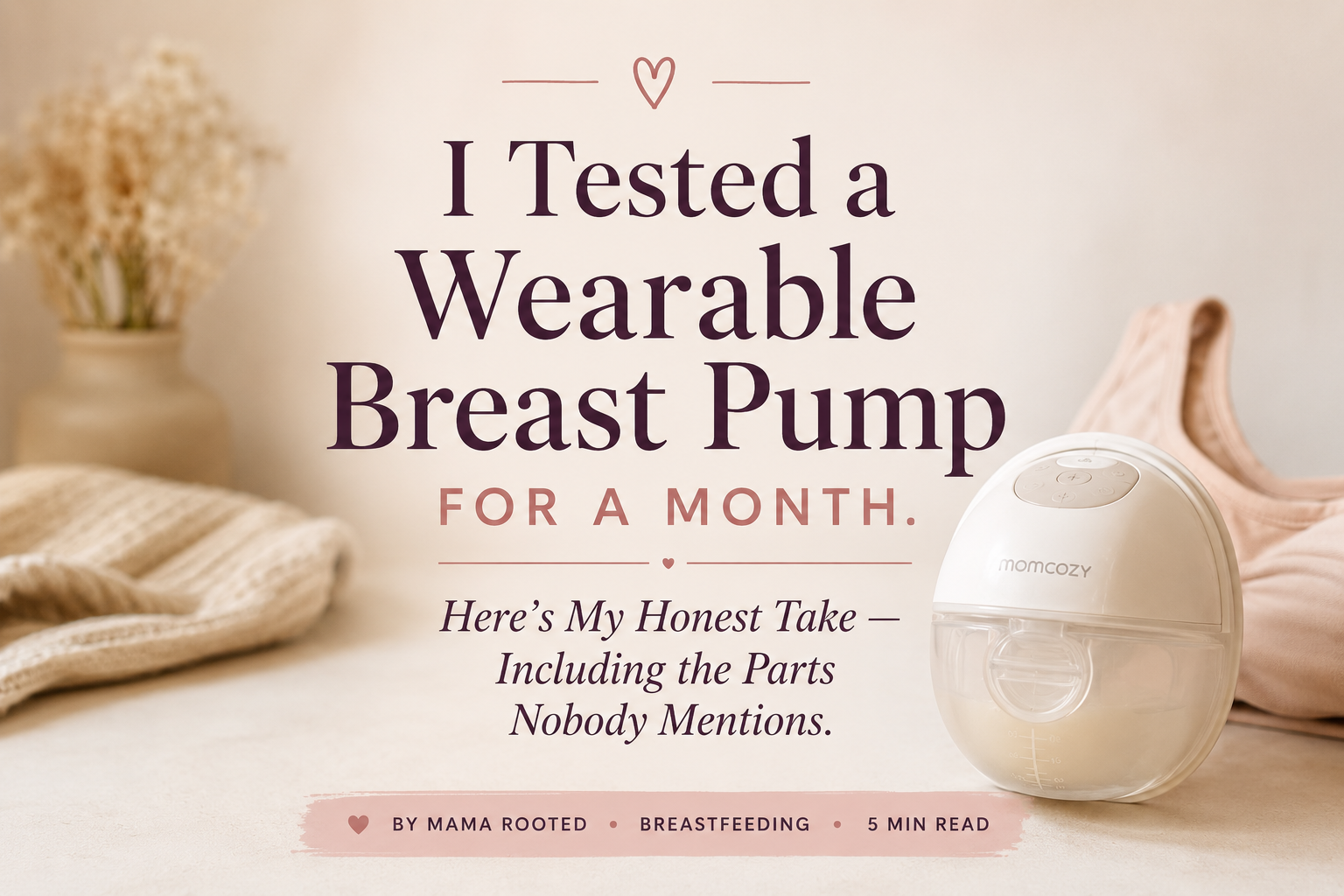
  • I Tested a Wearable Breast Pump for a Month. Here’s My Honest Take — Including the Parts Nobody Mentions.

    I Tested a Wearable Breast Pump for a Month. Here’s My Honest Take — Including the Parts Nobody Mentions.

    Before I got the Momcozy wearable pump, my pumping life looked like this:

    Find a plug point.
    Sit down.
    Stay there for twenty minutes.
    Do not move too much.
    Try not to feel like you are tethered to a wall.

    With a baby, a to-do list, and approximately zero moments where sitting still for twenty minutes felt possible, that setup was getting old fast.

    So I tried the wearable.

    And I have thoughts.

    The short version: it did not replace every pump. It did not magically make pumping effortless. But for travel, errands, working from home, and any day where I needed my hands back, it changed everything.

    ⚠️ Affiliate Disclosure: This post contains affiliate links. As an Amazon Associate, I earn from qualifying purchases at no extra cost to you. I only recommend things I personally used or carefully researched.


    Quick verdict — is the Momcozy M5 worth it?

    For me, yes — but only for the right use.

    I would buy the Momcozy M5 wearable pump again if I needed:

    • A pump for travel days
    • Something portable for errands or car rides
    • A secondary pump to use around the house
    • A way to pump without being stuck beside a plug point
    • More flexibility while still breastfeeding or pumping

    I would not choose it as my only pump if I were exclusively pumping or trying to build/protect supply with every session.

    That distinction matters.

    This is not the pump I would buy to replace a strong double electric pump for heavy-duty pumping.

    This is the pump I would buy for freedom.


    What a wearable pump actually is — and what it is not

    A wearable breast pump sits inside your bra.

    No external motor.
    No tubes hanging off you.
    No plug.
    No sitting still beside a wall for twenty minutes.

    It is battery-powered, self-contained, and — if you size the flange correctly — genuinely comfortable enough to wear while moving around.

    But it is important to be clear about what it is not.

    A wearable pump is not always the best replacement for a hospital-grade or strong double electric pump, especially if you are exclusively pumping or pumping to build or protect supply.

    For that kind of pumping, a plugged-in double electric like the Spectra S2 will usually be the more dependable primary pump.

    The Momcozy wearable is brilliant at what it is designed for:

    Mobility.
    Convenience.
    Travel.
    Around-the-house multitasking.
    Pumping when life with a baby does not pause for pumping.

    That is where it shines.


    Where it genuinely changed things for me — travelling

    The moment I understood what the wearable pump was actually for was on a trip.

    No searching for a family room.

    No hunting for a quiet corner with an outlet.

    No unpacking the pump, the tubing, the bottles, the adapter, and everything else that makes pumping feel like setting up a small machine.

    I put it on in the bathroom, got dressed over it, and got on with the day.

    I pumped in the car.

    I pumped while moving through a terminal.

    I pumped while having a conversation.

    That freedom is not a small thing when you are travelling with a baby and the whole day already feels like logistics.

    The Momcozy M5 — which is the one I used — lasted me through travel days on a full charge, which made a big difference. I did not feel like I had to constantly think about where the next outlet was.

    It also comes with multiple flange sizes — 17mm, 19mm, 21mm, and 24mm — so you have a better chance of finding the right fit from the beginning.

    And that matters more than anything.

    With pumps, fit is not a tiny detail.

    Fit is comfort.
    Fit is output.
    Fit is whether you dread using the thing or actually reach for it.

    At home, the wearable meant I could cook dinner, sort laundry, sit at my desk, move through the house, and pump at the same time.

    If you have ever sat attached to a wall pump watching the clock, you know how different that feels.


    The honest tradeoffs — because there are some

    I liked the Momcozy M5, but I do not want this to sound like a perfect product.

    It is not.

    There are a few things I wish every wearable pump review said more clearly.

    1. It is not silent

    The motor is audible.

    Not loud. Not embarrassing. Not impossible to use around people.

    But present.

    You will notice it, and in a quiet room, someone near you may notice it too.

    For errands, car rides, travel, and around the house, this did not bother me. For a silent work call, I would be more careful.

    2. You cannot bend freely

    Wearable pumps are not made for leaning forward.

    If you bend too much, you risk leaking or spilling.

    I learned this quickly.

    Upright positions only while it is running.

    That means you can move around, but you still have to move like someone who knows there is milk sitting inside her bra.

    3. Flange fit is everything

    If the pump hurts, feels uncomfortable, or gives low output, do not immediately assume the pump is bad.

    Check the flange size first.

    This is true for all pumps, but I found it especially true with wearables.

    Because the pump sits inside your bra, the fit has to be right. The insert size, the position, and how securely it sits all affect the session.

    Momcozy including several sizes in the box makes this easier to test.

    4. I would not use it as my only pump if I were exclusively pumping

    This is the biggest one.

    If I were exclusively pumping, or pumping to build and protect supply, I would keep a double electric pump as my primary.

    The wearable would be my secondary pump.

    A brilliant secondary pump.

    But still secondary.

    That is not a criticism. It is just knowing what the product is best at.


    Who this pump is actually for

    The Momcozy wearable is worth considering if any of these sound like you:

    • You travel with your baby
    • You need to pump during day trips, flights, or car rides
    • You work from home and want to pump without stopping everything
    • You are returning to work and need something portable
    • You already have a primary pump and want a more flexible second option
    • You are tired of being anchored to a socket
    • You want something you can use while doing normal life around the house

    This is where the wearable makes sense.

    It is not trying to be the most powerful pump in the world.

    It is trying to make pumping fit into your actual life.

    And for me, that is exactly what it did.


    The product I would pair it with

    If you are using a wearable pump outside the house, especially on travel days, I would also think about milk storage.

    The Momcozy Portable Milk Chiller pairs really well with the wearable because it solves the next problem:

    Okay, I pumped. Now where does the milk go?

    If you are out for a long stretch — airport, hotel, day trip, road trip — having a way to keep milk cold means you are not dependent on finding a fridge immediately.

    Pump.
    Chill.
    Continue your day.

    That combination removed a lot of mental load for me while travelling.


    Bottom line

    The Momcozy M5 wearable breast pump did exactly what I needed it to do.

    It gave me back the ability to move while I pumped.

    For travel days especially, it became the pump I reached for without thinking.

    It is not silent.

    It is not spill-proof if you bend.

    It is not the pump I would choose as my only pump if I were exclusively pumping.

    But for what it is designed for — freedom, convenience, travel, and life with a baby that does not pause for pumping — it genuinely delivered.

    If you are buying one, my biggest advice is this:

    Measure properly.
    Try the flange inserts.
    Use it for the job it is best at.
    Do not expect a wearable to behave exactly like a wall pump.

    Once I understood that, I loved it for what it was.

    A freedom pump.

    Not my only pump.

    But the one that made pumping feel possible on the days I could not sit still.

    If you have questions about sizing, fit, or whether this would work for your specific situation, reach out. I am at mama-rooted.com/contact and I am happy to help you figure out what makes sense for you.

    📌 Save this for any pumping mama who is tired of being tied to the wall.

    Lots of love,
    Mama Rooted


    Also on Mama Rooted

  • Everyone Told Me My Baby Was Hungry. I Chose Not to Believe Them Without Proof.

    Everyone Told Me My Baby Was Hungry. I Chose Not to Believe Them Without Proof.

    There was a week around the eight-week mark where I was convinced I was losing my milk.

    She was feeding constantly. Pulling off. Crying. Going back on. The feeds that used to feel predictable suddenly had no end. I was googling “low milk supply signs” at 2am with one hand while she nursed with the other.

    And I was sure.

    Absolutely sure.

    That my body was failing her.

    It was not.

    But here is the part nobody talks about enough: I did not just have my own doubts to manage.

    I had everyone else’s too.

    ⚠️ Affiliate Disclosure: This post contains affiliate links. As an Amazon Associate, I earn from qualifying purchases at no extra cost to you. I only recommend things I personally used or carefully researched.


    If you are panicking about your supply tonight

    Here is the short version before we get into the whole story:

    • A fussy, cluster-feeding baby does not automatically mean low milk supply.
    • Soft breasts do not automatically mean empty breasts.
    • Pump output does not always show how much milk your baby is getting.
    • Wet diapers, weight gain, and professional assessment matter more than worried comments.
    • If something feels wrong, call your pediatrician, midwife, or lactation consultant.
    • If you are in pain, or your baby is not gaining well, do not wait it out alone.

    What helped me most was not guessing.

    It was getting someone qualified to look at my actual baby, my actual latch, and my actual feeding situation.

    After that, the practical things helped too: feeding on demand, eating properly again, keeping water beside me, and using the Haakaa so I could see that milk was still there.

    But the first step was evidence.

    Not panic.


    The comments that nearly broke me

    When a baby wakes more often, seems fussier than usual, or cluster feeds until ten at night — people notice.

    And people have opinions.

    “Maybe she’s not getting enough.”

    “Her tummy probably isn’t filling up properly.”

    “Have you thought about topping her up?”

    These comments came from people who loved us. People who were worried. People who genuinely thought they were helping.

    I understand that now.

    But in the moment — sitting in that nursing chair, exhausted, emotional, and already convinced something was wrong — those words were destabilising.

    Because when someone you love says, “Maybe you are just not making enough,” your brain files that away as evidence.

    It stacks on top of the googling.

    It stacks on top of the soft breasts.

    It stacks on top of the long feeds.

    And before long, you are not just worried. You are certain.

    The well-meaning comments of the people around you can shake your breastfeeding confidence more than almost anything else.

    Not because they are cruel. Because they land when you are at your most vulnerable.


    What I chose to do instead

    I chose not to accept the verdict without evidence.

    That sounds simple.

    It was not. It took a real, deliberate decision to say:

    I am not going to act on this fear — or on what other people are telling me — until someone qualified has actually looked at this situation and told me there is a problem.

    So I called a lactation consultant.

    She did a weighted feed. She weighed my daughter before and after nursing. She watched the latch. She watched me. She looked at the whole picture.

    And then she told me, in a completely matter-of-fact way, that nothing was wrong. My daughter was transferring milk efficiently. What I was experiencing sounded like supply regulation.

    The cluster feeding was demand, not distress.

    The soft breasts meant my supply had started to calibrate, not disappear.

    That appointment changed everything.

    Not because she said something I could never have read online.

    But because it was a qualified professional who had actually looked at my baby, my latch, and my specific situation — and given me real information instead of a guess.

    If you are in this moment right now, please hear this:

    A worried comment is not evidence.

    Get the professional opinion first.

    Then decide.

    You can find an IBCLC through ILCA, or ask your pediatrician, midwife, OB, or hospital for a lactation referral.


    What was actually happening at week eight

    She was cluster feeding.

    For two or three evenings in a row, she would be on and off the breast from about five in the evening until nine or ten at night.

    I was sitting in the same spot, same nursing pillow, same water bottle, barely moving.

    My breasts felt softer between feeds than they had in the early weeks.

    What I thought was happening:

    My milk was going.

    What was actually happening:

    My supply was settling into a new rhythm.

    The early post-birth hormone surge had eased. My body was starting to shift from that full, engorged early feeling into a more regulated supply. The cluster feeding was my daughter signalling my body to make what she needed.

    A soft breast at eight weeks is not automatically an empty breast.

    Sometimes it is a breast that is learning what it is doing.

    But I did not know to expect this.

    So I spent a week convinced I was failing.


    What low milk supply actually is, and what it is not

    Low milk supply is real.

    Some mothers genuinely do need support with supply. Some babies do need supplementation. Some situations need quick medical attention. I do not want to minimize that.

    But what feels like low supply is not always low supply.

    Sometimes it is a growth spurt.

    Babies often cluster feed intensely during growth spurts. She may not be telling you the milk is gone. She may be asking your body to make more.

    Sometimes it is supply regulation.

    In the first weeks, many mothers feel fuller, leakier, and more obviously “full.” Then engorgement eases. Breasts soften. Leaking may slow down.

    That can feel terrifying if nobody warned you.

    But softer breasts alone do not mean your milk is disappearing.

    Sometimes it is latch, letdown, distraction, or tiredness.

    Pulling off, fussing, and seeming frustrated at the breast can happen for reasons that are not supply. Letdown may be faster or slower. Baby may be overtired. Baby may need help with latch or positioning.

    This is exactly why having someone qualified observe a feed can be so helpful.

    Call your pediatrician, midwife, or lactation consultant if you notice things like:

    • Fewer than 6 wet diapers in a day
    • Ongoing weight loss or poor weight gain
    • Baby not regaining birth weight in the expected window
    • Signs of dehydration
    • Baby consistently seeming weak, sleepy, or unable to feed effectively
    • Severe nipple pain, cracked nipples, bleeding, or feeds that make you dread latching
    • Your instinct telling you something is not right

    If you are seeing those signs, please do not wait and hope.

    Get help.

    But if your baby is gaining, having enough wet diapers, and the main issue is that she is suddenly feeding constantly while everyone around you is panicking, it may not be a supply crisis.

    It may be a hard, normal breastfeeding phase that needs support, not fear.


    What I did, and what helped

    I took my nutrition seriously again

    I was lucky enough to have the first forty days after birth held by my family in the way Indian culture has practiced for generations.

    Warm, nourishing food made for a recovering postpartum body and a breastfeeding mother.

    Ajwain water.

    Soaked almonds.

    Ghee.

    Warm meals, always warm.

    I do not think this was coincidence.

    The food I ate in those first forty days made a real difference to how I felt and, I believe, to how my body recovered and established breastfeeding.

    I have written about it in detail in my post on what my family fed me for the first 40 days after birth. The short version is this:

    Nutrition is not a cute extra during breastfeeding.

    It is the foundation.

    During the week of doubt, I realized I had let the eating slip.

    Too busy.

    Too tired.

    Too preoccupied with the feeds to actually feed myself properly.

    Going back to eating regularly — warmly, properly, and enough — was one of the most concrete things I did to support myself.

    Not as a magic supply fix.

    As basic care for a body doing enormous work.


    I kept water beside me before every feed

    Breastfeeding thirst is its own category of relentless.

    I had also been forgetting to fill my water bottle during that week.

    And while water alone does not magically solve supply, being underfed, overtired, and under-hydrated does not help any mother feel steady.

    I went back to keeping my HydroJug Traveller filled before feeds.

    Not because it was going to instantly “boost milk.”

    Because I was breastfeeding for hours and needed water where I could reach it.

    That mattered.


    I fed on demand, not on a schedule

    Every time she signalled hunger, I fed.

    Not because it was easy.

    It was not.

    But because frequent milk removal is one of the clearest ways the body gets the message to keep making milk.

    In a moment of worry about supply, feeding more often — while getting proper support if something feels wrong — made more sense than trying to stretch feeds or force a schedule.

    The evenings were long.

    The cluster feeds were intense.

    But I kept reminding myself:

    This is information my body is receiving.

    This is not proof that my body is failing.


    I added the Haakaa

    The Haakaa silicone pump attaches to the opposite breast while you nurse and catches letdown passively.

    No motor.

    No cords.

    No complicated parts.

    No extra pumping session to mentally prepare for.

    I started using it during feeds and was genuinely surprised by how much I was collecting without trying.

    This helped me in two ways.

    Practically, it helped build a small stash without turning pumping into another full-time job.

    Emotionally, it gave me visible reassurance.

    Seeing actual milk in a container when my brain was telling me there was none was grounding in a way I had not expected.

    It was not the only reason I kept breastfeeding.

    But in that week, it helped quiet the panic.


    I stopped watching the clock and started watching her

    The lactation consultant said something that I come back to often:

    The evidence you need is a fed, growing baby.

    Not how full your breasts feel.

    Not how long the feed lasts.

    Not what one pumping session yields.

    Not what someone else thinks from across the room.

    A baby who is gaining, feeding effectively, and having enough wet diapers is giving you real information.

    Everything else needs context.


    What I did not do

    I did not accept “your baby is hungry” as a conclusion just because someone said it with confidence.

    The people around me were not being unkind.

    They were worried.

    They were filling in the gaps with the logic that seemed obvious:

    Waking more often must mean hungry.

    Hungry must mean not enough milk.

    Not enough milk must mean top up.

    That logic feels airtight from the outside.

    But it is not always true.

    I chose not to act on it — not to change everything, not to supplement out of panic, not to give up — until someone who was actually qualified to assess the situation had done so.

    That decision protected my breastfeeding journey.

    I also did not stop feeding.

    Even on the hardest evenings of that week, even when it felt endless and pointless, I kept going while I got help.

    Because stopping abruptly out of fear could have created the supply drop I was afraid of having.


    The two things I would buy again for that week

    If you are in that supply-panic window and trying to make the next feed feel less overwhelming, these are the two things I would buy again first.

    1. The Haakaa silicone pump

    For passive milk collection and visible reassurance.

    It did not replace professional support. It did not diagnose anything. But it helped me see that my body was still making milk, and it helped build a small stash without adding another full pumping session.

    2. A large water bottle that actually stays beside you

    For the hours you spend trapped under a feeding baby.

    I used the HydroJug Traveller because it held enough water, had a straw, and lived beside my nursing chair.

    It was not glamorous.

    It was useful.

    And if latch pain is part of your story, do not just buy products and hope it goes away.

    Get the latch checked.

    Nipple cream, silver cups and Boppy nursing pillow can help comfort and healing, but they cannot fix a latch issue by themselves.

    The latch is the root.

    The products are support.


    What I would tell you right now

    If you are in this moment — if someone has said, “Maybe she is just not getting enough,” and it has lodged in your chest and you cannot get it out — I want you to hear this:

    A comment is not a diagnosis.

    Your fear is not proof.

    Your soft breasts are not proof.

    Your baby wanting to feed again is not proof.

    Get the professional opinion.

    Take your nutrition seriously.

    Drink the water.

    Keep feeding if your baby is able to feed and you have not been told otherwise.

    Ask for help before the fear makes the decision for you.

    The doubt you are feeling is not evidence that you are failing.

    It is evidence of how much you love her.

    You deserve real support, not guesses.

    You deserve to make the next decision from information, not panic.

    Lots of love,
    Mama Rooted

    📌 Save this for any mama whose confidence in her supply is being chipped away by the people around her. She needs to read this.


    Also on Mama Rooted

  • What My Indian Family Fed Me for 40 Days — and Why It Actually Worked for My Milk Supply

    What My Indian Family Fed Me for 40 Days — and Why It Actually Worked for My Milk Supply

    ⚠️ Affiliate Disclosure: This post contains affiliate links. I may earn a small commission at no extra cost to you. I only recommend things I have personally used or carefully researched.

    Three days after I came home from the hospital, my mother-in-law walked into the kitchen, looked at the chai I’d made for myself, took it right out of my hand, replaced it with a glass of warm ajwain water, and said:

    I was exhausted, slightly delirious, and honestly really wanted my chai back.

    But she was right.

    In Indian households, the first forty days after birth — the chilla or japa maas — are treated as a sacred recovery window. The diet is deliberate. Every ingredient has a purpose. It’s not just food, it’s medicine. And as a vegetarian trying to breastfeed for two years, I leaned into this hard.

    I also wanted to know the why behind it. Why oatmeal in every lactation cookie recipe? What were the soaked almonds actually doing? Was the fennel water just for digestion or something more?

    This post is what I learned — from lived experience, from my family, and from the science that quietly backed up what Indian women have known for centuries. None of it is magic. All of it helped.

    First — what even is a galactagogue?

    A galactagogue is any food or herb believed to support or increase breast milk production. And here’s the honest truth: the science on most of them is still catching up. We don’t have a mountain of clinical trials. What we do have is centuries of cross-cultural use, a body of emerging research, and a very simple truth — the foods most commonly used as galactagogues are also just excellent food for a postpartum body.

    A well-nourished, well-rested body that feeds frequently makes milk. The galactagogue supports the system. It doesn’t replace the feeding.

    What I actually ate — and why

    Oatmeal — my everyday anchor

    Every other morning, sometimes daily. Steel-cut oats, warm, with soaked almonds and a drizzle of ghee. Not glamorous. Completely grounding.

    Oats contain beta-glucan, which may help stimulate prolactin — the hormone that signals your body to make milk. They’re also good for iron, and low iron is a real reason some moms see supply dip. The comfort factor is real too — a warm familiar meal that lowers your stress is genuinely supporting your let-down. That’s physiology, not wishful thinking.

    How I used it: Steel-cut or rolled oats — never instant. Cooked with cardamom, topped with soaked almonds, a little ghee, sometimes stewed mango. Ground flaxseed stirred in most mornings.

    Fennel + ajwain water — the morning ritual

    Every single morning for six weeks, my mother-in-law steeped equal parts fennel seeds and ajwain (carom seeds) in hot water, strained it, and handed it to me before I’d even fed the baby. I thought it was just for digestion — and it is, postpartum constipation is very real — but it was doing more than that.

    Fennel contains a compound called anethole which may interact with prolactin pathways. It also passes digestive comfort to the baby through milk, which is something I genuinely noticed. Ajwain supports gut health, and a gut that isn’t absorbing properly can’t supply nutrients to milk no matter what you eat. The pairing is intentional.

    How I used it: Equal parts in hot water every morning.

    Sesame + flaxseed — the calcium and omega-3 team

    As a vegetarian, calcium was one of my biggest worries. Your body will pull from your own bone density to keep breast milk calcium-rich. So if you’re not replenishing it, you are the one paying the price.

    Sesame seeds — in chutney, in til laddoos, sprinkled on rice, blended into tahini — were in our kitchen daily. Ground flaxseed went into my oats every morning. The omega-3s from flaxseed actually make it into breast milk and support baby’s brain development. It’s worth noting that flaxseed needs to be ground — whole seeds pass through without being absorbed. Always ground.

    How I used it: Flaxseed into oats daily. Sesame in chutney, tempering, tahini, and til laddoos made in a batch before the due date.

    Almonds — the snack that was always within reach

    I soaked ten almonds the night before, peeled them in the morning, and it became a ritual I came to love.

    I also kept a jar of almond butter on my nightstand. Breastfeeding burns roughly 500 calories a day and I would wake up at 2am absolutely ravenous. Having something calorie-dense and actually nutritious within arm’s reach without going to the kitchen is not a luxury — it is survival. If nothing else, do this.

    Chickpeas — my protein problem-solver

    Getting enough protein as a vegetarian postpartum requires actual intention. It doesn’t just happen. Chickpeas became one of my most reliable sources — in curries, as salad, and most consistently as hummus that lived permanently in my fridge.

    The hummus came with tahini, which meant I was getting sesame’s calcium and phytoestrogen benefits folded in without even thinking about it. That’s the kind of effortless nutrition that actually works when your brain is running on no sleep.

    My hummus formula: Three tablespoons of tahini minimum. Lemon, garlic, olive oil. Made a big batch every four days. Eaten on crackers, on toast, with vegetables, occasionally just on a spoon at 11pm.

    Brewer’s yeast — make the cookies before you give birth

    I made lactation cookies two weeks before my due date, stored them in the freezer, and had my husband put five on a plate every night so they’d be thawed by the 2am feed. This is the planning nobody tells you about.

    Post-delivery you will not be baking. You will not be doing anything that requires sustained standing. Make them before. Freeze them. You will thank your pregnant self a hundred times over.

    Brewer’s yeast is one of the most consistently reported galactagogues in US breastfeeding surveys. It’s also packed with B vitamins that support energy and mood — both very relevant in postpartum. In cookie form you won’t taste the bitterness at all.

    My base recipe: Rolled oats, almond butter, coconut oil, brewer’s yeast, ground flaxseed, dark chocolate chips, honey or maple syrup. No oven needed if you roll into balls. Freeze for up to three months.

    Ghee — not optional in our house

    Ghee went into everything. My oatmeal. My dal. My khichdi, which I ate almost daily in the first two weeks because it’s warm and nourishing and requires minimal chewing at 3am. My family would have been concerned if I wasn’t using it.

    Ghee is clarified butter — pure butterfat, milk solids removed. It carries fat-soluble vitamins A, D, E and K2 and is traditionally believed to support digestion and gut recovery postpartum.. Your gut after delivery needs support, and ghee is one of the most bioavailable ways to give it. Ayurveda has documented this for thousands of years. Nutrition science arrived at the same conclusion.

    For vegan mamas: coconut oil is the closest alternative — good digestibility, similar gut support profile. The principle is the same: prioritise quality fat.

    Moringa — the one I’d tell every breastfeeding vegetarian about

    Moringa (drumstick leaves) is one of the most studied plant-based galactagogues globally, particularly in South Asian research. It’s also one of the most nutrient-dense greens you can get. In leaf form it went into our dals and sabzis. In powder form a small teaspoon stirred into smoothies.

    If you’re vegetarian and breastfeeding and not using moringa, consider adding it. It’s easy, it’s effective, and a little goes a long way.

    Quick reference — everything in one place

    If you’re exhausted and just want the simple version, here’s everything I kept coming back to again and again. This is the full list. The “Amazon find” column is there if you want a starting point.

    FoodWhy it helpsVegan?Amazon find
    Coconut OilGreat Source of Healthy FatsYeshttps://amzn.to/4vn2UAX
    OatmealMay boost prolactin; good for ironYesQuaker rolled Oats
    Fennel seedsPhytoestrogens; milk volume + colic relief for babyYesOrganic Fennel Seeds
    Ajwain / carom seedsDigestive support + milk productionYesOrganic Ajwain Seeds
    Ground flaxseedOmega-3 ALA into breast milk; phytoestrogensYesOrganic Ground Flaxseed
    Sesame seeds / tahiniCalcium, iron, zinc — critical for vegetariansYesSoom Premium Tahini
    Almonds (soaked)Calcium, vitamin E, healthy fatsYesBarney Almond Butter

    Raw Almonds
    ChickpeasProtein, iron, isoflavonesYesOrganic Canned Chickpeas
    AvocadoCalorie-dense healthy fat; supports milk fat qualityYesBetter Body Avocado Oil
    Brewer’s yeastB vitamins, iron, protein — energy + moodYesLewis Labs Brewer’s Yeast
    GheeFat-soluble vitamins A/D/E/K2; butyrate for gut healingNoAncient Organics Grass-Fed Ghee
    Moringa powderOne of best-studied plant galactagogues; vitamins + mineralsYesOrganic Moringa Powder
    Methi (fenugreek leaf)Phytoestrogens — leaf is gentler than seedYesDried Methi Leaves (Kasuri Methi)

    The thing I want you to actually hear

    Food does not make milk on its own.

    I say this because in my most anxious new-mother moments I convinced myself that if I could just eat the right things, supply would sort itself out. That’s not how it works. Milk production is demand-driven — your body makes milk in response to milk being removed. Frequency of nursing or pumping is the single biggest factor. Full stop.

    What galactagogues do is support the environment your body is operating in. They are the fertile soil. The nursing is the rain. One without the other doesn’t work.

    If you’re genuinely worried about supply, please call a lactation consultant before you do anything else. A good IBCLC will see things no food list can.

    My mother-in-law was right. Slow down. Eat intentionally. Let your body do what it was built to do.

    – With love, Mama Rooted

    Save this post and share it with a vegetarian or vegan mama who’s figuring out breastfeeding. She needs this list. 🤍

  • I Breastfed for 2 Years. Here’s the Honest Truth About All of It.

    I Breastfed for 2 Years. Here’s the Honest Truth About All of It.

    ⚠️ Affiliate Disclosure: This post contains affiliate links. If you buy through my links I may earn a small commission at no extra cost to you. I only recommend things I have personally used or carefully researched for fellow moms.

    I want to start by saying something I didn’t hear enough when I was in the thick of it:

    Breastfeeding is hard. Like, really hard. And if you’re struggling right now, you are not doing it wrong. You are just in the hard part.

    I breastfed my daughter for two full years. I weaned her just recently — in three days, which honestly felt like its own kind of miracle and its own kind of heartbreak at the same time. (I’ll write a whole separate post on weaning soon because that chapter deserves its own space.)

    But today I want to go back to the beginning. To the raw nipples and the 2am crying — mine, not always hers. To the moment I almost quit at week three. And to how I got through it and came out the other side feeling like I had done something extraordinary.

    Here is everything — the real stuff, not the highlight reel.

    In a hurry? Check out my entire breastfeeding essentials collection on Amazon right here.

    The First Four Weeks: Honestly the Hardest Thing I’ve Done

    Nobody warned me that the first latch would feel like that. I genuinely gasped the first few times. My nipples were raw, cracked, and so sore that I would tense up the moment my daughter started rooting.

    My milk supply was all over the place those first weeks. Some feeds felt fine, some she came off screaming like she hadn’t gotten anything. I was constantly wondering if she was getting enough, checking her diapers obsessively, Googling at midnight.

    What actually turned things around for me was getting a lactation consultation. I cannot stress this enough — if you are struggling, please don’t wait as long as I did to ask for professional help. A good International Board Certified Lactation Consultant will assess your latch, check for tongue tie, and help you figure out your supply situation in a way that no YouTube video or well-meaning family member can. You can find a certified consultant near you through ILCA — the International Lactation Consultant Association. It was one of the best things I did for both of us.

    In the meantime, these are what got me through those early weeks physically:

    • Silverettes: I cannot overstate how much these helped. Silverette Silver Nursing Cups sit over your nipples between feeds and the silver genuinely seemed to have healing properties — not just marketing fluff.
    • Nipple Cream: I went through almost two tubes of Lansinoh HPA Lanolin Nipple Cream in the first month alone. Apply after every single feed. Don’t skip it.
    • Nursing Pillow: The Boppy Original Nursing Pillow saved my back and helped me get a better latch position. When you’re feeding every 2 hours, your arms and shoulders take a beating without support.
    • Nipple Shield: My lactation consultant suggested trying a Medela Contact Nipple Shield during the rockiest first weeks. It gave my skin a tiny break while she still fed. Not a forever solution but a bridge when you need one. Available in multiple sizes so you can choose your perfect fit.

    The Complicated Relationship I Had With Pumping: My Medela Was My Best Friend and Worst Enemy

    I pumped from around week three — partly to build a small freezer stash, partly because there were times my daughter wouldn’t latch and I didn’t want to miss a feed.

    I used the Spectra S1 and it was solid. Hospital-grade suction, double electric, and it came with everything I needed to get started. It’s FSA/HSA eligible too which is worth knowing if you have a flex spending account through work.

    A few things that made pumping more manageable:

    Bottles: Because Even Exclusively Breastfed Babies Sometimes Need One

    Even though I was exclusively breastfeeding, there were times — a rare night out, a doctor’s appointment — where my husband or mom would give a bottle of pumped milk. Introducing a bottle too early can cause nipple confusion so I waited until around 6 weeks.

    We used Dr. Brown’s Natural Flow Anti-Colic Bottles as they were one of the most recommended by lactation consultants specifically for breastfed babies because the slow flow nipple prevents them from getting lazy at the breast. I have also heard great reviews from friends of mine about this Comotomo Natural Feel Baby Bottle — the squishy silicone body is designed to feel more like a breast.

    Cluster Feeding: The Phase I Was Not Remotely Prepared For

    Nobody told me about cluster feeding before it happened and when it did I genuinely thought something was wrong.

    Cluster feeding is when your baby wants to nurse constantly — like every 30-45 minutes. It’s their way of telling your body to make more milk. It’s completely normal. It also feels completely insane when you’re living through it.

    During cluster feeding phases I kept:

    The 2am Feeds: Real Talk

    My daughter did not sleep through the night before she was one year old. Not once.

    We were up every two hours for months. There were nights I cried right along with her, sitting in the dark, absolutely exhausted, wondering how people did this. There were nights I genuinely questioned everything.

    And then there were the other nights. The ones where she would fall asleep on my chest mid-feed and her little hand would be curled around my finger and the whole house was quiet and I just sat there not wanting to move.

    Both things were true at the same time. That’s what nobody prepares you for. It’s hard and it’s sacred at the same time.

    A few things that made night feeds survivable:

    Keeping Up My Milk Supply: What Actually Helped

    Supply anxiety is real and I had it bad in the early months. A few things I genuinely believe helped me maintain supply for two years:

    • Legendairy Milk Liquid Gold Capsules —Really clean ingredients. I used these from month two onward.
    • Milkmakers Lactation Cookie Bites — oats, brewer’s yeast, flaxseed. I had two every afternoon. Also just a nice excuse for a snack.
    • Oatmeal every single morning. Nothing fancy, just regular rolled oats. Boring but it works.
    • Staying hydrated — truly, genuinely, aggressively hydrated. I aimed for 100oz of water a day while nursing.
    • Not skipping feeds or pumping sessions, especially in the early months. Your supply is supply and demand — the more consistently you feed, the more your body makes.
    • Ensuring I get good balance of fats from my meals for an adequate calorie intake.

    Two Years Later: What I Want You to Know

    I weaned my daughter at two years. Three days. She was ready and so was I and it was peaceful and a little sad and mostly just felt right.

    Looking back at the whole journey — the cracked nipples, the cluster feeding marathons, the nights I cried in the dark — I would do all of it exactly the same way again.

    Not because it was easy. It wasn’t.

    Because it was ours. This quiet, exhausting, tender thing that happened between me and my daughter every few hours for two years. That is a chapter I will carry with me forever.

    If you’re in week one right now, barely holding on — hang in there. Get a lactation consultant. Use the Silverettes. Ask your partner to bring you water. It does get easier.

    And if you decide breastfeeding isn’t for you, or your body has other plans — that is okay too. A fed baby and a mentally healthy mama beats everything.

    📌 Save this post for the mamas in your life who are about to start their feeding journey. And if you’re in the thick of it right now — I see you. You’re doing great.

    Also on Mama Rooted:

    My milk supply dropped and I thought I was failing — what actually happened

    The postpartum feeding station — everything within arm’s reach before you sit down

    Breastfeeding in the first week — what nobody warns you about

    Everything Mentioned in This Post

    If you’re building your own breastfeeding survival cart right now, these are the products I personally kept within arm’s reach every day. All Amazon links are affiliate links.