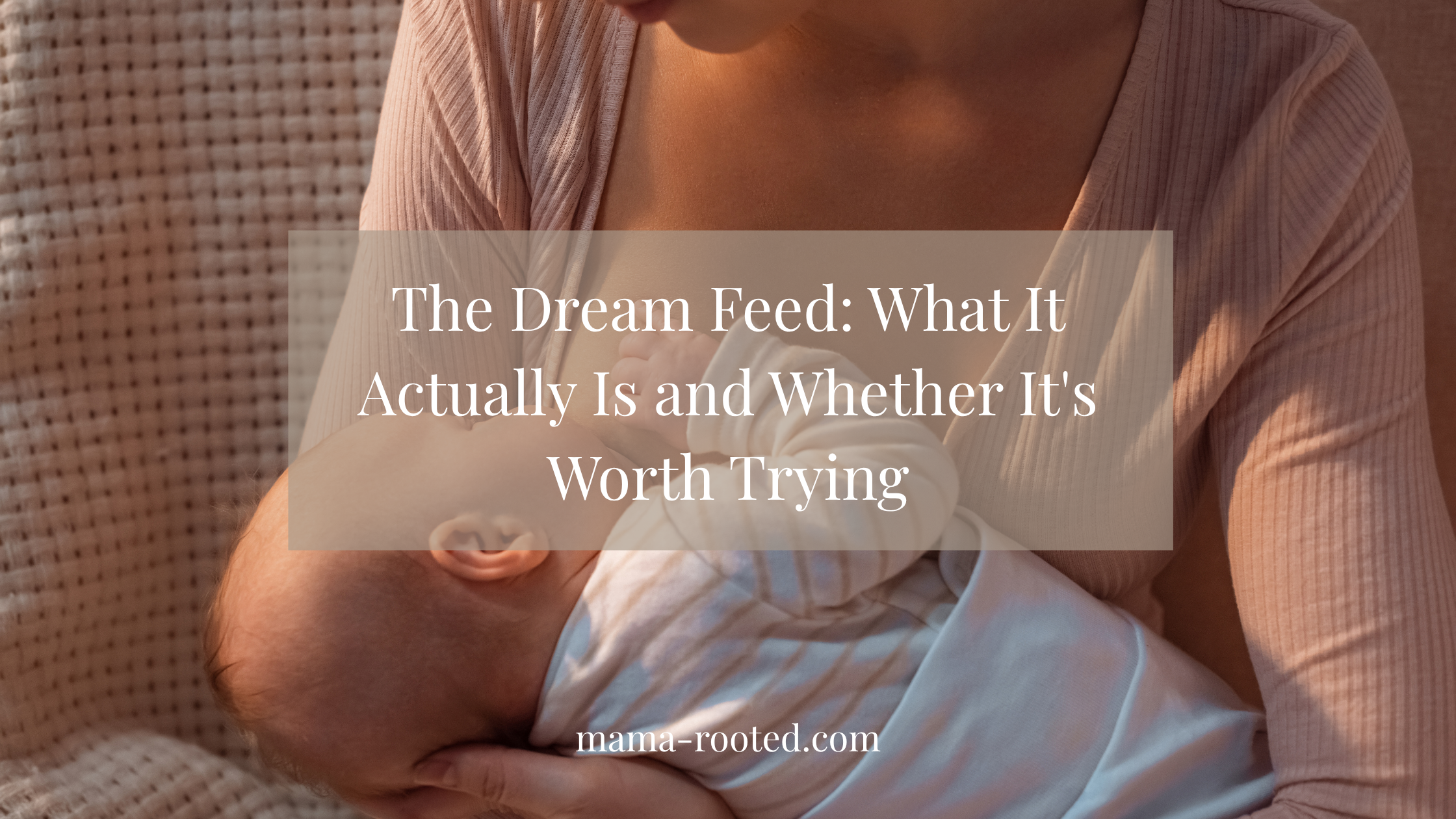
If you’ve spent any time in baby sleep forums, you’ve probably seen people mention dream feeding like it’s some secret weapon for getting a longer stretch of sleep.
I was skeptical too. Feeding a baby who was barely awake sounded a little ridiculous.
But once I understood what a dream feed actually was — and what it could and couldn’t do — it became something I could look at a little more realistically.
Here’s what I learned.
What Is a Dream Feed?
A dream feed is a late-evening feed offered when your baby is sleepy or drowsy, usually before you go to bed.
The idea is to gently rouse your baby enough to feed without turning it into a full wake-up. Some babies will nurse or take a bottle while still very sleepy.
The hope is that another feed before you go to bed might help your baby settle into a longer first stretch of sleep.
The important part: a dream feed isn’t supposed to mean putting milk into a completely sleeping or unresponsive baby’s mouth. Your baby should be awake enough to feed effectively.
And it isn’t a guarantee that they’ll sleep longer afterward. Babies have very different feeding and sleep patterns, and waking overnight is still completely normal, especially in the younger months.
A Sample Dream Feed Schedule
There’s no perfect dream-feed schedule, but here’s an example of how it might fit into an evening for a baby who already has a bedtime routine:
- 7:00 PM – Bedtime feed + normal bedtime routine
- 7:30 PM – Baby goes down
- 10:30–11:00 PM – Dream feed, before you go to bed
- Overnight – Baby wakes whenever they naturally need to
- 6:30–7:00 AM – Morning wake-up
The dream feed simply sits between baby’s bedtime and your bedtime.
The goal isn’t to force a particular overnight schedule. You’re just seeing whether that extra late-evening feed changes the first stretch of sleep for your baby.
Think of this as an example, not a schedule your baby needs to follow.
For most healthy, full-term babies, feeding is still guided by hunger and fullness cues rather than trying to make the clock dictate every feed. Babies with specific feeding or growth concerns may need a different plan from their pediatrician.
When Should You Start Dream Feeding?
This is where I think a lot of baby-sleep advice gets unnecessarily specific.
You’ll see people give a particular age — but there isn’t a universal age when every baby should start dream feeding.
Instead, I’d think about your baby’s individual situation.
In the early newborn weeks, frequent feeding is normal. Some babies also need to be woken for feeds depending on their age, weight gain and medical circumstances. So I wouldn’t introduce a dream feed as a way of trying to stretch a young newborn’s overnight feeding without first making sure their feeding needs are being met. We introduced mine at around 3 months.
If you’re unsure whether your baby should still be waking to feed, that’s a question for your pediatrician rather than a sleep schedule on the internet.
And when should you stop?
There’s no magic stopping age either.
You might stop when:
- Your baby starts resisting the late-night feed
- The feed wakes them up instead of settling them
- You don’t notice any difference in their overnight sleep
- Your baby is naturally sleeping through that part of the night without it
- It simply becomes one more thing you don’t want to do at 10:30 PM
If it’s no longer helping, you don’t need to keep doing it just because someone told you that you should. We actually stopped at around the 5 month mark because it wasn’t working as well as we had hoped around then.
Does Dream Feeding Actually Work?
Honestly?
It depends on the baby.
For some babies, an extra late-evening feed seems to help create a longer first stretch of sleep.
For others, it changes absolutely nothing.
And that’s important because overnight waking isn’t always about hunger. Babies also wake as part of normal sleep patterns, and younger babies naturally wake frequently because they need to eat often.
So if your baby still wakes at 1 AM after a 10:30 PM dream feed, that doesn’t necessarily mean you did it wrong.
It may simply mean your baby still needed to wake.
A Few Things Nobody Really Tells You
It can become another thing to maintain.
The first few nights, a dream feed can feel like a brilliant idea.
Then suddenly you’re standing in a dark nursery at 10:45 PM thinking:
Do I really have to do this every night?
If it becomes more work than it’s worth, that’s worth paying attention to.
It doesn’t fix sleep.
A dream feed is a feeding strategy, not a sleep-training method.
It isn’t going to magically teach your baby to sleep independently, and it isn’t going to prevent every sleep disruption or regression.
It can sometimes wake your baby up more.
Some babies go straight back down.
Others seem to think:
Oh, we’re awake now? Great.
And suddenly your carefully planned dream feed has turned into a 45-minute middle-of-the-night party.
If feeding makes your baby more alert or harder to settle, that’s useful information too.
Your baby may simply have their own schedule.
This was probably the most important thing for me to remember.
You can change the timing of a feed, create a beautiful bedtime routine and do everything “right” — and your baby can still wake up at the exact same time.
That doesn’t mean you failed.
So, Is a Dream Feed Worth Trying?
Maybe.
If your baby is feeding well and there isn’t a medical reason you need to follow a different feeding plan, you can talk with your pediatrician about whether a late-evening feed makes sense for your situation.
Then give it a fair try for a few nights and actually watch what happens.
Does the first stretch get longer?
Does your baby go back to sleep easily?
Are you getting more sleep?
Or are you just adding another feed to your night?
That’s the information that matters.
If you don’t notice a meaningful difference after trying it, you don’t have to keep forcing it.
The dream feed isn’t a test you pass or fail. It’s just one thing you can try.
And if it doesn’t work for your baby?
That’s completely normal.
One Important Safe-Sleep Note
A dream feed shouldn’t mean feeding a deeply sleeping or unresponsive baby.
Your baby should be awake enough to feed effectively. After the feed, put your baby back in their own safe sleep space, on their back, on a firm, flat sleep surface.
The American Academy of Pediatrics recommends room-sharing without bed-sharing for at least the first six months, with the baby’s sleep space close to your bed but separate from it.
My Take
I went into dream feeding thinking it might be the thing that finally solved those middle-of-the-night wake-ups.
But I think it’s more useful to look at it for what it actually is:
One extra feed that may help some babies sleep for a longer first stretch — and may do absolutely nothing for others.
You don’t need to make it part of your routine forever.
Try it if it makes sense for you.
Keep it if it helps.
And let it go if it doesn’t.
Because sometimes the best baby-sleep advice isn’t “here’s the trick that worked.”
It’s:
“Here’s something you can try — and here’s how to know when it’s not working for you.”
Lots of love
Mama Rooted
Also on Mama Rooted
- My baby would only sleep on me — what we did and what finally let me put her down
- The 4-month sleep regression — what it actually is and how we got through it
- Baby sleep essentials — what we actually used, including through the regression

Leave a Reply