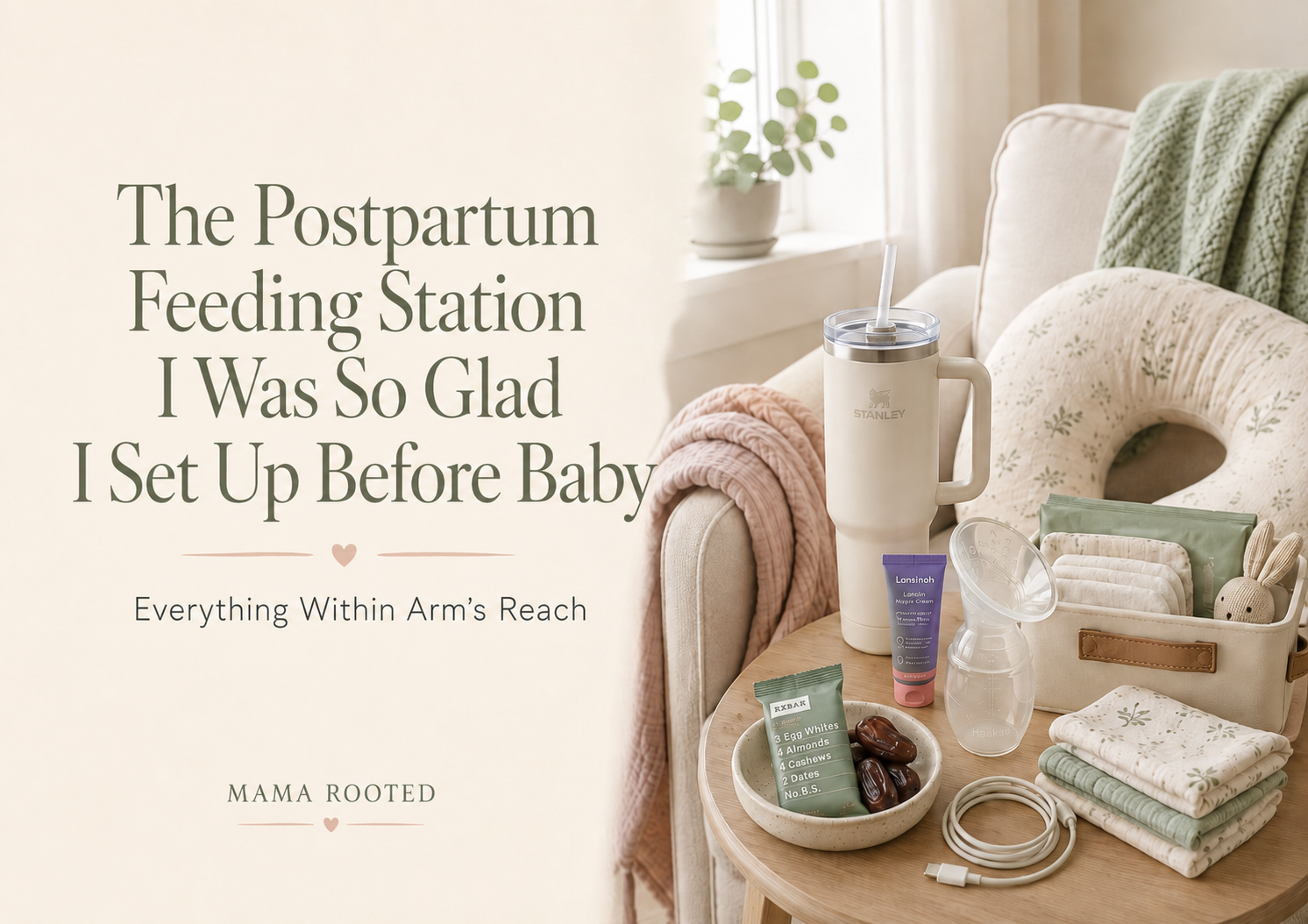
The first few weeks of feeding a newborn — whether you’re breastfeeding, pumping, bottle feeding or all three — happen around the clock.
You will feed on the sofa. In bed. On the nursing chair at 2am. In positions you didn’t know your body could hold. For stretches of time that blur together.
The one thing that makes all of it more survivable: having everything you need within arm’s reach before you sit down.
Because once the baby latches — or once you’ve got the bottle angle right and she’s finally settled — you are not getting up. You are not asking anyone to bring you anything. You are sitting there until she’s done.
Set up your feeding station before the baby arrives. Third trimester you has the time. Postpartum you will not.
First — where does the station live?
Pick the spot where you’ll actually spend most of your feeding time. For most moms that’s one of three places:
- A dedicated nursing chair in the nursery — if you have space and you’re planning to use it
- A comfortable armchair or sofa corner in the living room — where you’ll be during the day
- Your side of the bed — for night feeds, this is where the postpartum cart already lives
Ideally you set up a version in all three places. A full station at your main daytime spot, a pared-down version next to the bed for nights. The items are largely the same — it’s just about which things need to be where.
Affiliate Disclosure: This post contains affiliate links. I may earn a small commission at no extra cost to you.
The chair — worth getting right
You will spend hundreds of hours in this chair in the first year.
The most important thing is back support. Breastfeeding without proper support — hunching forward, craning your neck to see the latch — leads to shoulder and neck pain that compounds over weeks. A chair with a proper back, armrests at the right height, and enough room to shift position during a long feed is not a luxury. It’s functional.
If you already have a comfortable armchair that works, use it. If you’re choosing one specifically for feeding, look for:
- A straight, supportive back — not a deep sink-in sofa
- Armrests at roughly the height of your elbows when seated
- Enough seat depth that you can sit with your back against the backrest and still have feet flat on the floor
- Easy to wipe clean — spills are guaranteed
The Graco Glider Elite Gliding Chair and the DaVinci Olive Upholstered Swivel Glider are both well-reviewed options with the support and cleanability you need.
The nursing pillow — non-negotiable
Do not try to hold the baby at the right feeding height with just your arms for weeks on end. Your shoulders will not survive it.
A nursing pillow wraps around your waist and brings the baby up to breast or bottle height, freeing your arms and keeping your back in a neutral position. I used mine at every single feed for at least 8 months.
The Boppy Original Nursing Pillow is the most recommended and the one I’d choose. The My Brest Friend Nursing Pillow is a good alternative with a firmer, flatter surface that some moms prefer for latch positioning.
Water — more than you think you need
Breastfeeding thirst is its own category of desperate. It hits mid-feed when both hands are occupied and you cannot do anything about it.
Keep a large insulated tumbler at the station — filled before you sit down, every single time. The HydroJug Traveller 40oz keeps water cold for hours and the straw means you can drink without adjusting position or dislodging the baby. This is the one I used every day.
Rule: fill it before you sit down. Every time. Without exception.
Snacks — one-handed and within reach

Breastfeeding burns hundreds of extra calories a day. Your body is working constantly. Hunger hits fast and hard, especially at night.
Keep snacks at the feeding station that:
- Can be eaten with one hand
- Don’t require unwrapping or preparation
- Are actually filling — not just something to chew
What worked for us:
- RXBAR Protein Bars — no wrapper fuss, genuinely filling, clean ingredients
- Kind Protein Bars — easy to eat one-handed, good variety
- Medjool Dates — natural sugar, iron, easy to grab one at a time
- A small jar of nut butter with a spoon — sounds odd, works brilliantly at 3am
Burp cloths and muslins — more than you think
You will go through more burp cloths per day than seems possible. Keep a proper stack at the station — not one or two, a stack.
Muslin cloths are better than standard burp cloths for this job. They’re large enough to actually protect your shoulder, absorbent, and dry fast between uses.
The Comfy Cubs Muslin Burp Cloths are the ones I’d recommend — bigger than standard, soft, and they hold up to constant washing. Keep at least six at the station.
Nipple cream — at every seat, not just one
If you’re breastfeeding: nipple cream should be within arm’s reach at every single place you feed. Not in the bathroom. Not in the nappy bag. Right there.
Apply after every feed in the first weeks — before the pain starts, not after. Lansinoh HPA Lanolin Nipple Cream is the one I used. Baby-safe, no need to wipe off before feeding, and the difference between using it and not using it in week one is the difference between manageable and miserable. Another thing I used along with it was the Earth Mama Nipple butter. Very moisturizing and soothing.
The extras that matter more than you expect

A few small things that round out the station:
- Phone charger. Long cable, plugged in. You will be on your phone at every feed. Running out of battery at 3am with a baby attached is its own category of miserable.
- Kindle. If you like reading like me, having a Kindle on hand makes the day feeds a little more manageable.
- A small basket or caddy for everything. The Parker Baby Diaper Caddy works brilliantly here — use it to corral the snacks, cream, burp cloths and phone charger so nothing migrates.
- Haakaa silicone pump. If you’re breastfeeding, keep the Haakaa at the station. Attach to the opposite breast at every feed and catch the letdown passively. Thirteen dollars. Builds a freezer stash without trying.
- Hatch Go sound machine. For nap feeds where you’re trying to settle without fully waking, the Hatch Go Portable clips onto the chair and keeps the white noise going wherever you move.
The night version — pared down for 3am
At the bedside, you don’t need everything. You need the essentials and nothing that requires thought:
- Water tumbler — filled before bed, every night
- Two or three burp cloths — folded and stacked
- Nipple cream — within reach without turning on a light
- One protein bar or handful of dates — for the 3am hunger
- Phone charger plugged in
- Hatch nightlight at its lowest setting — enough to see by, not enough to wake you both up properly
The night station rule: if you have to get up to get it, it doesn’t belong on the night station. Everything you need at 3am should be reachable without leaving the bed.
Set it up before the baby comes
I set up our main feeding station at around 34 weeks. By the time I came home from the hospital, everything was already in its place.
Every feed for the first six weeks, I sat down and everything I needed was right there. No asking anyone. No getting up. No thinking.
That’s the whole point of setting it up early. The less you have to think during a feed, the more energy you have for everything else.
Set it up now. Postpartum you will be very glad you did. Lots of love, Mama Rooted.

📌 Save this and send it to anyone building a feeding station for the first time.
Part of the Mama Rooted postpartum prep series:
The postpartum cart — everything on mine, tier by tier
The nesting party checklist — what to ask people to do before baby arrives
My first 40 days morning routine
Amazon Subscribe and Save — what to set up before baby arrives
My Honest Postpartum Recovery Must Haves

Leave a Reply