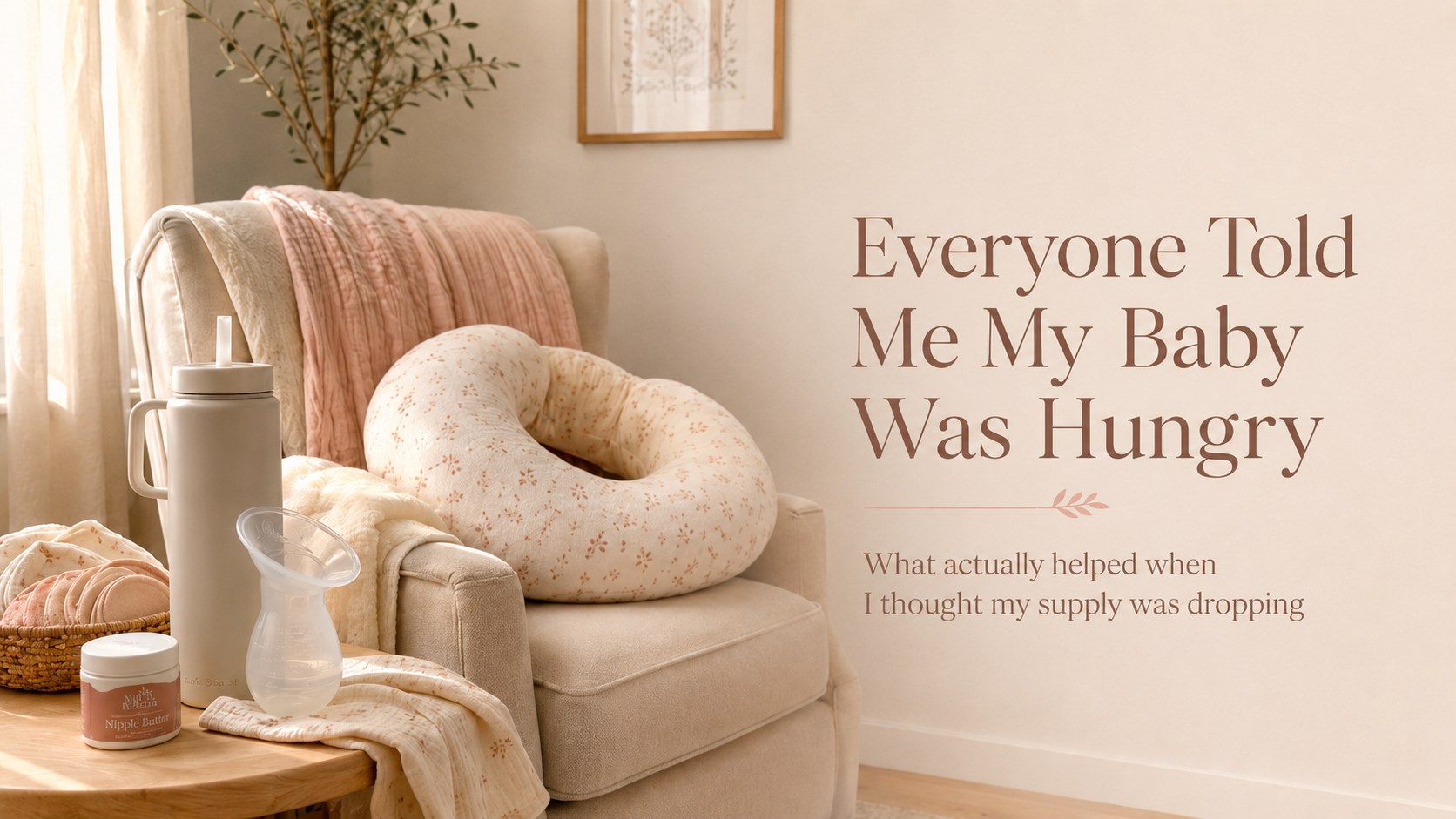
There was a week around the eight-week mark where I was convinced I was losing my milk.
She was feeding constantly. Pulling off. Crying. Going back on. The feeds that used to feel predictable suddenly had no end. I was googling “low milk supply signs” at 2am with one hand while she nursed with the other.
And I was sure.
Absolutely sure.
That my body was failing her.
It was not.
But here is the part nobody talks about enough: I did not just have my own doubts to manage.
I had everyone else’s too.
⚠️ Affiliate Disclosure: This post contains affiliate links. As an Amazon Associate, I earn from qualifying purchases at no extra cost to you. I only recommend things I personally used or carefully researched.
If you are panicking about your supply tonight
Here is the short version before we get into the whole story:
- A fussy, cluster-feeding baby does not automatically mean low milk supply.
- Soft breasts do not automatically mean empty breasts.
- Pump output does not always show how much milk your baby is getting.
- Wet diapers, weight gain, and professional assessment matter more than worried comments.
- If something feels wrong, call your pediatrician, midwife, or lactation consultant.
- If you are in pain, or your baby is not gaining well, do not wait it out alone.
What helped me most was not guessing.
It was getting someone qualified to look at my actual baby, my actual latch, and my actual feeding situation.
After that, the practical things helped too: feeding on demand, eating properly again, keeping water beside me, and using the Haakaa so I could see that milk was still there.
But the first step was evidence.
Not panic.
The comments that nearly broke me
When a baby wakes more often, seems fussier than usual, or cluster feeds until ten at night — people notice.
And people have opinions.
“Maybe she’s not getting enough.”
“Her tummy probably isn’t filling up properly.”
“Have you thought about topping her up?”
These comments came from people who loved us. People who were worried. People who genuinely thought they were helping.
I understand that now.
But in the moment — sitting in that nursing chair, exhausted, emotional, and already convinced something was wrong — those words were destabilising.
Because when someone you love says, “Maybe you are just not making enough,” your brain files that away as evidence.
It stacks on top of the googling.
It stacks on top of the soft breasts.
It stacks on top of the long feeds.
And before long, you are not just worried. You are certain.
The well-meaning comments of the people around you can shake your breastfeeding confidence more than almost anything else.
Not because they are cruel. Because they land when you are at your most vulnerable.
What I chose to do instead

I chose not to accept the verdict without evidence.
That sounds simple.
It was not. It took a real, deliberate decision to say:
I am not going to act on this fear — or on what other people are telling me — until someone qualified has actually looked at this situation and told me there is a problem.
So I called a lactation consultant.
She did a weighted feed. She weighed my daughter before and after nursing. She watched the latch. She watched me. She looked at the whole picture.
And then she told me, in a completely matter-of-fact way, that nothing was wrong. My daughter was transferring milk efficiently. What I was experiencing sounded like supply regulation.
The cluster feeding was demand, not distress.
The soft breasts meant my supply had started to calibrate, not disappear.
That appointment changed everything.
Not because she said something I could never have read online.
But because it was a qualified professional who had actually looked at my baby, my latch, and my specific situation — and given me real information instead of a guess.
If you are in this moment right now, please hear this:
A worried comment is not evidence.
Get the professional opinion first.
Then decide.
You can find an IBCLC through ILCA, or ask your pediatrician, midwife, OB, or hospital for a lactation referral.
What was actually happening at week eight
She was cluster feeding.
For two or three evenings in a row, she would be on and off the breast from about five in the evening until nine or ten at night.
I was sitting in the same spot, same nursing pillow, same water bottle, barely moving.
My breasts felt softer between feeds than they had in the early weeks.
What I thought was happening:
My milk was going.
What was actually happening:
My supply was settling into a new rhythm.
The early post-birth hormone surge had eased. My body was starting to shift from that full, engorged early feeling into a more regulated supply. The cluster feeding was my daughter signalling my body to make what she needed.
A soft breast at eight weeks is not automatically an empty breast.
Sometimes it is a breast that is learning what it is doing.
But I did not know to expect this.
So I spent a week convinced I was failing.
What low milk supply actually is, and what it is not
Low milk supply is real.
Some mothers genuinely do need support with supply. Some babies do need supplementation. Some situations need quick medical attention. I do not want to minimize that.
But what feels like low supply is not always low supply.
Sometimes it is a growth spurt.
Babies often cluster feed intensely during growth spurts. She may not be telling you the milk is gone. She may be asking your body to make more.
Sometimes it is supply regulation.
In the first weeks, many mothers feel fuller, leakier, and more obviously “full.” Then engorgement eases. Breasts soften. Leaking may slow down.
That can feel terrifying if nobody warned you.
But softer breasts alone do not mean your milk is disappearing.
Sometimes it is latch, letdown, distraction, or tiredness.
Pulling off, fussing, and seeming frustrated at the breast can happen for reasons that are not supply. Letdown may be faster or slower. Baby may be overtired. Baby may need help with latch or positioning.
This is exactly why having someone qualified observe a feed can be so helpful.
Call your pediatrician, midwife, or lactation consultant if you notice things like:
- Fewer than 6 wet diapers in a day
- Ongoing weight loss or poor weight gain
- Baby not regaining birth weight in the expected window
- Signs of dehydration
- Baby consistently seeming weak, sleepy, or unable to feed effectively
- Severe nipple pain, cracked nipples, bleeding, or feeds that make you dread latching
- Your instinct telling you something is not right
If you are seeing those signs, please do not wait and hope.
Get help.
But if your baby is gaining, having enough wet diapers, and the main issue is that she is suddenly feeding constantly while everyone around you is panicking, it may not be a supply crisis.
It may be a hard, normal breastfeeding phase that needs support, not fear.
What I did, and what helped
I took my nutrition seriously again
I was lucky enough to have the first forty days after birth held by my family in the way Indian culture has practiced for generations.
Warm, nourishing food made for a recovering postpartum body and a breastfeeding mother.
Ajwain water.
Soaked almonds.
Ghee.
Warm meals, always warm.
I do not think this was coincidence.
The food I ate in those first forty days made a real difference to how I felt and, I believe, to how my body recovered and established breastfeeding.
I have written about it in detail in my post on what my family fed me for the first 40 days after birth. The short version is this:
Nutrition is not a cute extra during breastfeeding.
It is the foundation.
During the week of doubt, I realized I had let the eating slip.
Too busy.
Too tired.
Too preoccupied with the feeds to actually feed myself properly.
Going back to eating regularly — warmly, properly, and enough — was one of the most concrete things I did to support myself.
Not as a magic supply fix.
As basic care for a body doing enormous work.
I kept water beside me before every feed
Breastfeeding thirst is its own category of relentless.
I had also been forgetting to fill my water bottle during that week.
And while water alone does not magically solve supply, being underfed, overtired, and under-hydrated does not help any mother feel steady.
I went back to keeping my HydroJug Traveller filled before feeds.
Not because it was going to instantly “boost milk.”
Because I was breastfeeding for hours and needed water where I could reach it.
That mattered.
I fed on demand, not on a schedule
Every time she signalled hunger, I fed.
Not because it was easy.
It was not.
But because frequent milk removal is one of the clearest ways the body gets the message to keep making milk.
In a moment of worry about supply, feeding more often — while getting proper support if something feels wrong — made more sense than trying to stretch feeds or force a schedule.
The evenings were long.
The cluster feeds were intense.
But I kept reminding myself:
This is information my body is receiving.
This is not proof that my body is failing.
I added the Haakaa
The Haakaa silicone pump attaches to the opposite breast while you nurse and catches letdown passively.
No motor.
No cords.
No complicated parts.
No extra pumping session to mentally prepare for.
I started using it during feeds and was genuinely surprised by how much I was collecting without trying.
This helped me in two ways.
Practically, it helped build a small stash without turning pumping into another full-time job.
Emotionally, it gave me visible reassurance.
Seeing actual milk in a container when my brain was telling me there was none was grounding in a way I had not expected.
It was not the only reason I kept breastfeeding.
But in that week, it helped quiet the panic.
I stopped watching the clock and started watching her
The lactation consultant said something that I come back to often:
The evidence you need is a fed, growing baby.
Not how full your breasts feel.
Not how long the feed lasts.
Not what one pumping session yields.
Not what someone else thinks from across the room.
A baby who is gaining, feeding effectively, and having enough wet diapers is giving you real information.
Everything else needs context.
What I did not do
I did not accept “your baby is hungry” as a conclusion just because someone said it with confidence.
The people around me were not being unkind.
They were worried.
They were filling in the gaps with the logic that seemed obvious:
Waking more often must mean hungry.
Hungry must mean not enough milk.
Not enough milk must mean top up.
That logic feels airtight from the outside.
But it is not always true.
I chose not to act on it — not to change everything, not to supplement out of panic, not to give up — until someone who was actually qualified to assess the situation had done so.
That decision protected my breastfeeding journey.
I also did not stop feeding.
Even on the hardest evenings of that week, even when it felt endless and pointless, I kept going while I got help.
Because stopping abruptly out of fear could have created the supply drop I was afraid of having.
The two things I would buy again for that week
If you are in that supply-panic window and trying to make the next feed feel less overwhelming, these are the two things I would buy again first.
1. The Haakaa silicone pump
For passive milk collection and visible reassurance.
It did not replace professional support. It did not diagnose anything. But it helped me see that my body was still making milk, and it helped build a small stash without adding another full pumping session.
2. A large water bottle that actually stays beside you
For the hours you spend trapped under a feeding baby.
I used the HydroJug Traveller because it held enough water, had a straw, and lived beside my nursing chair.
It was not glamorous.
It was useful.
And if latch pain is part of your story, do not just buy products and hope it goes away.
Get the latch checked.
Nipple cream, silver cups and Boppy nursing pillow can help comfort and healing, but they cannot fix a latch issue by themselves.
The latch is the root.
The products are support.
What I would tell you right now
If you are in this moment — if someone has said, “Maybe she is just not getting enough,” and it has lodged in your chest and you cannot get it out — I want you to hear this:
A comment is not a diagnosis.
Your fear is not proof.
Your soft breasts are not proof.
Your baby wanting to feed again is not proof.
Get the professional opinion.
Take your nutrition seriously.
Drink the water.
Keep feeding if your baby is able to feed and you have not been told otherwise.
Ask for help before the fear makes the decision for you.
The doubt you are feeling is not evidence that you are failing.
It is evidence of how much you love her.
You deserve real support, not guesses.
You deserve to make the next decision from information, not panic.
Lots of love,
Mama Rooted

📌 Save this for any mama whose confidence in her supply is being chipped away by the people around her. She needs to read this.
Also on Mama Rooted
- What my family fed me for the first 40 days after birth — the Indian postpartum food tradition that supported my recovery and my milk supply
- The feeding station setup — everything within arm’s reach before you sit down

Leave a Reply